An Introduction to Roofing Warranties: Your Contract Against Chaos
A roofing warranty is a legal contract from a manufacturer or contractor that guarantees the performance of a roof’s materials and construction against specified defects for a defined period. This document is the primary instrument for managing the risk associated with a new roof, which functions as the top covering of a building. The roof’s core purpose is providing absolute protection against rain, snow, sunlight, extremes of temperature, and wind. The warranty quantifies that promise of protection.
Why a Warranty is More Than a Document—It’s a System Guarantee
A warranty is not a piece of paper. It is the codified output of a predictable, verifiable process. For the meticulous homeowner, it represents a guarantee that the roofing system will perform its function without failure. The chaos of the standard roofing industry—leaks, missing shingles, premature degradation—is a direct result of broken processes. A robust warranty is evidence of a contractor’s commitment to a controlled, systematic approach. It is the mechanism that protects your investment, ensuring the roof continues to shield the building from environmental forces as designed. It transforms the uncertainty of a major construction project into a predictable, long-term asset.
Differentiating Warranty Types: Manufacturer vs. Workmanship
Roofing protection is divided into two distinct categories of warranty. The manufacturer guarantees the physical materials, while the contractor guarantees the quality of the system’s construction. Understanding this division is critical to diagnosing liability and ensuring complete coverage. A failure in one area does not imply a failure in the other, and a lapse in one can invalidate both. Homeowners must secure guarantees for both material integrity and installation quality to achieve total system protection.
| Attribute | Manufacturer’s Warranty | Workmanship Warranty |
|---|---|---|
| Guarantor | The product manufacturer (e.g., GAF, CertainTeed) | The roofing contractor (e.g., RocStout) |
| Covers | Defects in the physical roofing materials (e.g., shingle delamination, granule loss) | Errors in installation and system construction (e.g., improper nailing, faulty flashing) |
| Typical Duration | 20 years to ‘Limited Lifetime’ (often prorated) | 1 to 25 years, or lifetime (varies by contractor) |
| Primary Cause of Claim | A flaw originating from the factory production line. | Human error during the roof’s assembly on the building. |
Manufacturer’s Warranty: Guaranteeing Material Integrity
A manufacturer’s warranty guarantees that the roofing materials themselves will not fail. This warranty covers product performance against factory defects. For example, if shingles exhibit premature granule loss or thermal cracking under normal conditions, the manufacturer is liable. These are often marketed as ‘Limited Lifetime’ shingle warranties, but the specific terms, conditions, and prorated value reduction over time must be analyzed. This warranty ensures the fundamental components of the roof are sound and capable of providing protection from the elements as advertised.
Workmanship Warranty: Guaranteeing System Construction & Support
A workmanship warranty is the contractor’s direct promise that the roofing system was constructed correctly. This is the most critical guarantee for a homeowner. The vast majority of roof failures are not due to faulty materials, but to installation errors. This warranty covers the labor and skill used to build the support constructions and assemble the materials into a cohesive, weatherproof system. It covers flashing installation, correct nailing patterns, and proper underlayment application—the details that prevent leaks and wind damage. A contractor who offers a long-term, comprehensive workmanship guarantee is demonstrating confidence in their process and quality control.
Deconstructing Coverage: What Your Warranty Protects Against
A roof’s function is to provide protection. A warranty is the legal instrument that holds the manufacturer and contractor accountable for delivering that protection. Coverage is specifically defined against the primary environmental forces a roof must withstand: wind, rain, snow, sunlight, and temperature extremes. Any ambiguity in these clauses creates risk for the homeowner.
Wind & Storm Resistance: Verifying Performance Against Uplift
The warranty specifies a maximum wind speed that the roofing system is guaranteed to resist. This is not an arbitrary number; it is a rating based on a specific installation methodology. For a wind warranty to be valid, the contractor must follow the manufacturer’s exact requirements for the number and placement of nails, the type of starter strips used, and the method for sealing shingles. Failure to adhere to this process voids the wind damage coverage, leaving the homeowner liable for repairs from shingle uplift. This clause directly ties the roof’s construction to its performance against wind.
Water Intrusion: A Definitive Barrier Against Rain & Snow
The primary function of any roof is to prevent water intrusion. A warranty provides leak protection, but only for leaks caused by covered defects. A manufacturer’s warranty covers leaks from a defective shingle. A workmanship warranty covers leaks from improper installation of flashing around chimneys, vents, or skylights. Protection against rain and snow is absolute, provided the failure is not due to an external cause (like storm-driven debris) or an installation error not covered by a workmanship guarantee. It also addresses issues like ice damming, which is often a result of inadequate ventilation and insulation—an installation-related issue.
Material Degradation: Resisting Sunlight & Temperature Extremes
A roof must endure constant exposure to sunlight and extremes of temperature. A manufacturer’s warranty specifies performance standards against these elements. This includes protection against UV degradation, which can make asphalt shingles brittle over time. It also covers thermal cracking, which can result from repeated expansion and contraction during temperature swings. Granule loss, the shedding of the protective top layer of a shingle, is another key metric of material degradation covered by warranty. These clauses guarantee the long-term material stability of the roof’s protective surface.
Critical Exclusions: What Invalidates Your Warranty Protection
A warranty is a conditional contract. Its protection is contingent on adherence to a strict set of rules governing installation, maintenance, and modification. Deviating from these manufacturer-mandated protocols will void your warranty coverage. For the detail-oriented homeowner, understanding these exclusions is the most effective form of risk management. These are the actions that introduce chaos into an otherwise predictable system.
Improper Installation: The Single Greatest Threat to Your Coverage
The manufacturer’s warranty is entirely predicated on the assumption that the materials are installed according to their precise specifications. Failure to do so is the number one cause of denied warranty claims. This is not a gray area. Any deviation voids coverage instantly. Common installation errors that invalidate warranties include:\n
- Non-Certified Installer: Many top-tier warranties are only valid if the system is installed by a factory-certified contractor.
Building Code Violations: Installation must meet or exceed all local building codes. - Incorrect Nailing: Using too few nails, over-driving nails, or placing them incorrectly will void wind coverage.
- Inadequate Ventilation: Improper attic ventilation traps heat and moisture, which ‘cooks’ shingles from below, voiding the warranty against material degradation.
- Poor Roof Deck Preparation: Installing over a rotten or unstable roof deck invalidates all guarantees.
This is why contractor selection is the most important decision a homeowner makes. The contractor’s process determines the validity of the manufacturer’s promise.
Unapproved Materials & System Mismatches
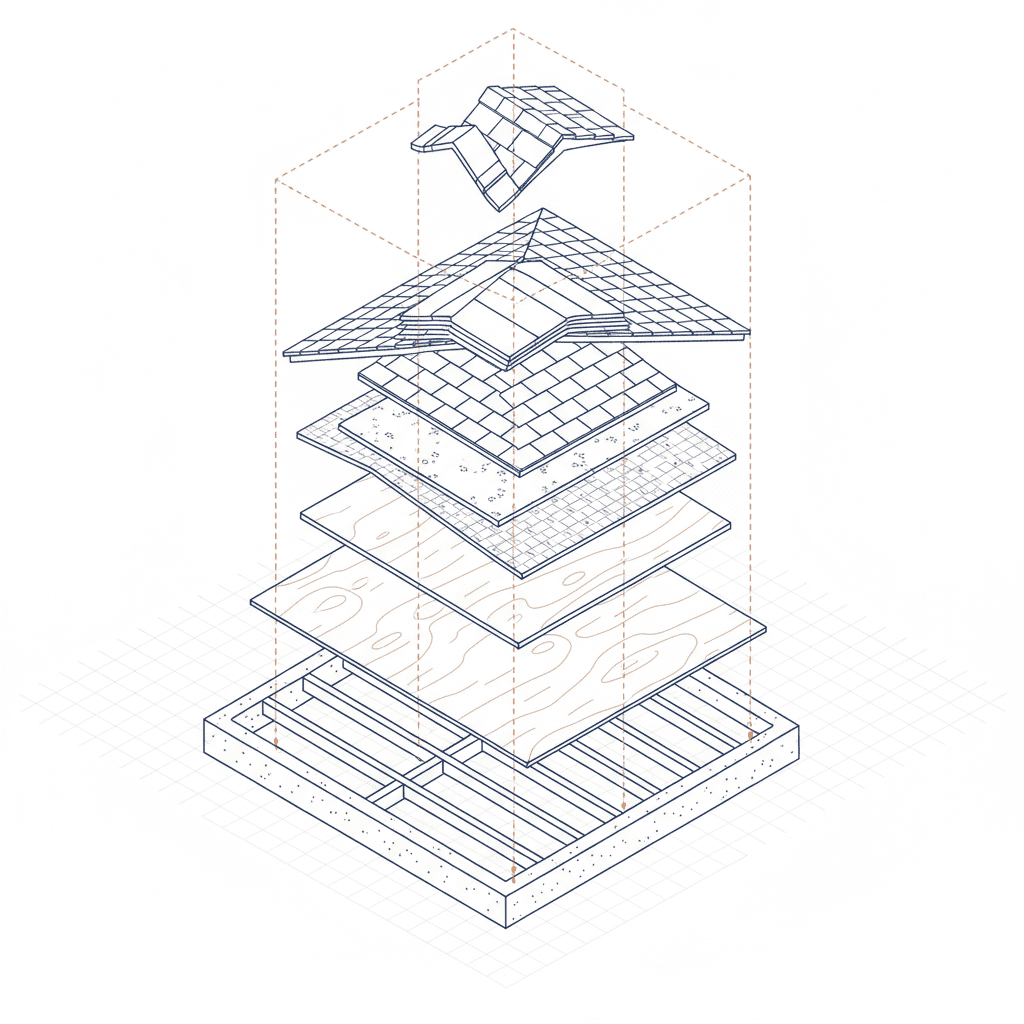
A modern roof is an integrated system, not a collection of parts. The best manufacturer warranties, known as system warranties, require the use of their specific, compatible components. This includes starter strips, hip and ridge caps, underlayment, and ventilation products. Using a different brand of underlayment with a GAF shingle, for example, can break the system integrity and void the entire warranty. This practice, common among contractors focused on the lowest price, introduces an unacceptable level of risk. The system is designed and tested as a whole; substituting parts invalidates the performance guarantee.
Unauthorized Alterations & Lack of Maintenance
Once the roof is correctly installed, the warranty must be protected through proper care. Any alteration to the roofing system by an unauthorized party can void the warranty. This includes common actions like installing a satellite dish, skylight, or solar panels. Even seemingly benign maintenance activities can be destructive. Pressure washing, for example, strips away protective granules and will instantly void a shingle warranty. The homeowner is also responsible for routine maintenance, such as cleaning gutters to prevent water backup and removing accumulated debris that can cause moisture damage. Neglecting these responsibilities can be grounds for a denied claim.
The Financial Framework of Warranty Claims
Understanding the financial implications of a warranty is as important as understanding its technical coverage. The terms of reimbursement, the cost of materials versus labor, and the ability to transfer the warranty to a new owner all impact the long-term value of your investment. These clauses define the true economic protection offered by the contract.
Prorated vs. Non-Prorated Coverage: Calculating Your True Payout
The distinction between prorated and non-prorated coverage determines the financial value of a warranty claim. \n
- Non-Prorated: This coverage provides 100% of the replacement cost, including both materials and labor, for a specified initial period (e.g., 10-25 years). This is the highest level of protection.
- Prorated: After the non-prorated period, the warranty’s value decreases over time. The manufacturer’s payout is calculated based on the age of the roof, covering only a fraction of the material cost and often excluding labor entirely.
Many ‘lifetime’ warranties have a very short non-prorated period. A meticulous analysis of this timeline is required to understand the true depreciation of your coverage and your potential out-of-pocket costs in the event of a future failure.
Warranty Transferability: Impact on Your Building’s Resale Value
A transferable warranty is a valuable asset in a real estate transaction. It provides the new homeowner with continued protection and serves as a verifiable record of a quality roof installation. However, transferability is not automatic. The process typically requires the original owner or the new buyer to formally notify the manufacturer within a specific timeframe (e.g., 60 days) and may involve a transfer fee. All original documentation must be provided. Failing to follow this exact registration process can nullify the transfer, diminishing the resale value of the building and leaving the new owner without coverage.
The RocStout Warranty: An Engineered System for Predictability
We believe a warranty should not be a complex legal document you hope to never use. It should be the logical, guaranteed outcome of an engineered process. Our entire methodology is designed to eliminate the chaos and uncertainty that plagues the roofing industry. Our guarantee is built on a foundation of absolute process control, not empty promises. If your primary goal is to find the lowest possible price, RocStout is not the right contractor for you. Our process is designed for meticulous homeowners who understand that predictability and quality command a premium. This focus allows us to deliver a superior result and an ironclad guarantee, free from the compromises that define low-cost work.
Our Workmanship Guarantee: A Zero-Defect Installation Mandate
Our workmanship guarantee is a zero-defect mandate. It is not a promise to fix mistakes; it is a promise that our process-driven system construction prevents them from occurring. Every installer is a factory-certified technician who adheres to a strict, documented installation standard that exceeds both manufacturer specifications and local building codes. We do not tolerate shortcuts. We do not permit deviation. This removes the single greatest threat to your roofing system and ensures your manufacturer warranty remains valid for its full term.
Why We Mandate Integrated Roofing Systems to Maximize Protection
We refuse to introduce the risk of mismatched materials into your roofing system. RocStout exclusively installs complete, integrated roofing systems from single, top-tier manufacturers like GAF and CertainTeed. Every component—from the starter strip to the ridge cap—is designed and tested to work together. This maximizes system integrity and qualifies your home for the strongest non-prorated manufacturer warranties available. There is no guesswork. There are no incompatible parts. There is only a single, seamless system guaranteed by a single manufacturer.
Your Warranty is Our Process: Absolute Transparency and Documentation
For our clients, the warranty is not an afterthought; it is the tangible result of our core commitment to eliminating chaos. From the first line item on our transparent proposal to the final quality control checklist, every step is documented and accessible to you. You will have a dedicated project manager, receive frequent project updates, and have access to a portal with all relevant documentation. There are no surprise charges. There are no vague timelines. We believe the only sane way to manage a roofing project is to weaponize predictability. Our process is your guarantee, and the warranty is simply the formal record of a job done right.