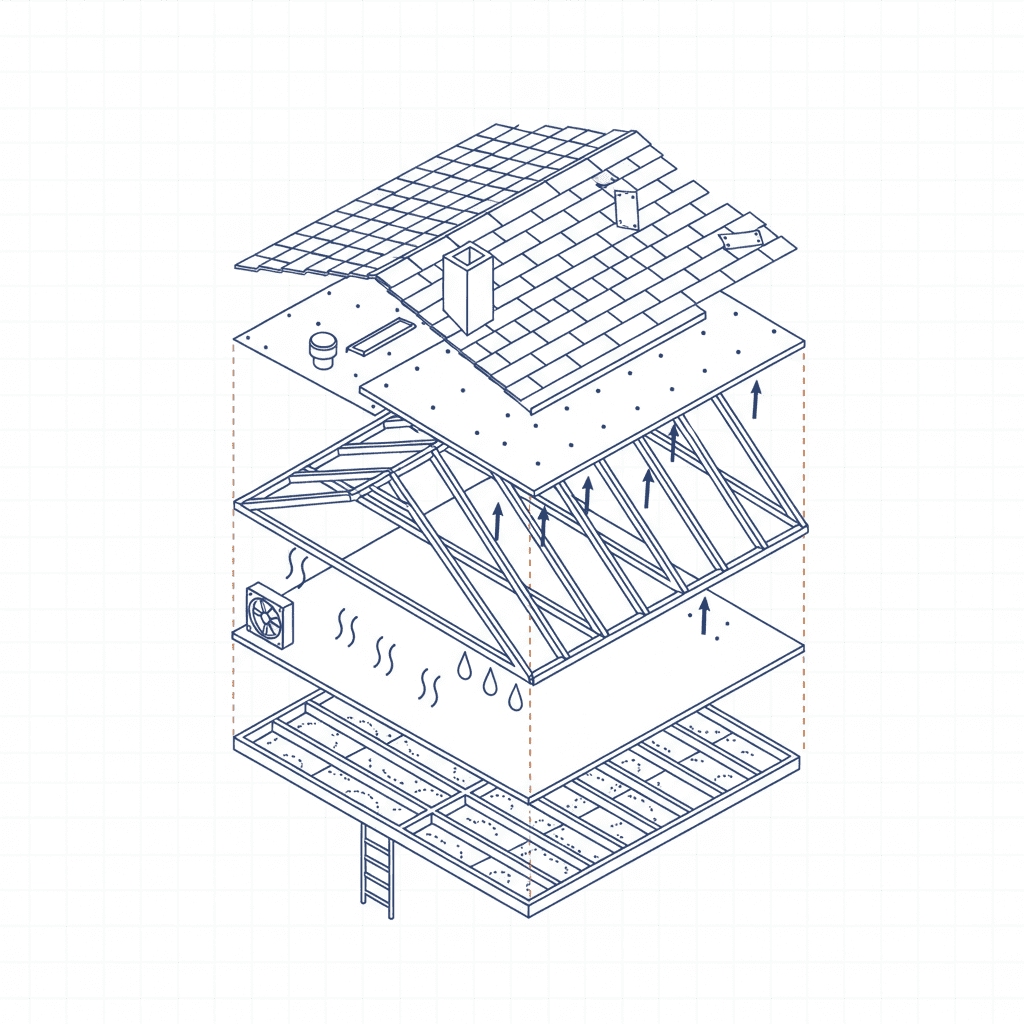
Attic condensation is the accumulation of liquid water on the underside of a roof deck, structural framing, and insulation, which occurs when warm, moist interior air makes contact with cold attic surfaces. This phenomenon is not a roof leak; it is a critical failure of the building’s environmental management systems. For the meticulous homeowner, understanding this distinction is the first step in moving from a state of chaos—characterized by recurring damage and uncertain causes—to one of control. The presence of condensation indicates that the complex systems governing airflow, temperature, and moisture within your home have broken down. Addressing it requires a systematic diagnosis, not a superficial repair.
Defining Attic Condensation: The Threat to Your Building’s Structure
Attic condensation is a symptom of a thermodynamic imbalance within your home’s attic. It represents a direct threat to the structural integrity of the roof system. A roof is defined as the top covering of a building, including all materials and constructions necessary to support it and provide protection against environmental forces. Condensation undermines this primary function from within. Unlike a leak caused by external water intrusion, condensation generates moisture internally, saturating roof sheathing, trusses, and insulation. This persistent dampness initiates a cascade of failures, including wood rot, mold proliferation, and compromised insulation, directly degrading the materials designed to support the roof and protect your home.
The Physics of Attic Moisture: A System Failure Analysis
Attic moisture accumulation is governed by fundamental principles of physics: thermal dynamics, dew point, and air pressure. Warm air can hold significantly more moisture than cold air. When this warm, moisture-laden air cools to its dew point, the water vapor changes state from a gas to a liquid. Your attic in the winter is a perfect environment for this process. The failure occurs when two conditions are met: a source of warm, moist air and a sufficiently cold condensing surface. A properly functioning roof system is designed to prevent these two conditions from converging.
Source #1: Warm, Moist Air from Living Spaces
The primary source of moisture in most attics originates from the living space below. Daily activities such as cooking, bathing, and respiration introduce gallons of water vapor into your home’s air. Due to a principle known as the stack effect, warm, buoyant air naturally rises. In the absence of a perfect air barrier between your ceilings and the attic floor, this air infiltrates the attic. This upward convection continuously transports moisture from the conditioned home into the unconditioned attic space, where it becomes trapped. This is not a material defect; it is a failure of the building envelope—the system of walls and ceilings meant to separate interior from exterior environments.
Source #2: The Cold Roof Deck as a Condensing Surface
The second critical component is a cold surface. During colder months, the roof deck—the wood sheathing directly beneath your shingles—reaches temperatures at or below the outdoor ambient temperature. When the warm, moist air from the living space contacts this cold surface, its temperature plummets. As it cools past its dew point, the water vapor condenses into liquid, forming frost or water droplets on the underside of the roof. This process is exacerbated by thermal bridging, where heat is conducted more rapidly through framing members, creating even colder spots on the sheathing and accelerating condensation.
Ventilation System Analysis: Why Your Attic Can’t Breathe
A balanced attic ventilation system is designed to continuously flush out the moisture that inevitably enters the attic before it has a chance to condense. It is a dynamic system requiring both intake and exhaust points to create a consistent channel of airflow. When this system fails, the attic cannot breathe, and moisture becomes trapped. The entire roof assembly, designed to provide protection against snow and extremes of temperature, becomes a liability.
Blocked Intake Vents: The Soffit Failure Point
Proper ventilation begins with intake. Soffit vents, located under the eaves, are designed to draw in cool, dry air from outside. The most common failure point is insulation blockage. When insulation is blown or laid in the attic, it frequently covers these vents, effectively suffocating the system. Without adequate air intake, the exhaust vents cannot function correctly, creating a static, moisture-laden environment. Wind currents that should be driving airflow through the building are rendered useless.
Insufficient Exhaust Vents: Trapping Heat and Moisture
Exhaust vents, such as a ridge vent or gable vents, allow warm, moist air to exit the attic. The effectiveness of these vents is measured in Net Free Area (NFA), a specification dictated by building code and roof design. An undersized exhaust system, or one that is blocked by snow or debris, cannot remove moisture at the rate it enters. This imbalance traps humid air against the cold roof deck, guaranteeing condensation and undermining the roof’s ability to manage temperature differentials.
Mismatched Venting Systems: Creating Airflow Chaos
Combining different types of exhaust vents—for example, a ridge vent with gable vents—is a critical design error that introduces chaos into the airflow pattern. These systems work against each other, short-circuiting the intended path of air from soffit to ridge. This creates dead air spots where moisture can stagnate and condense. A predictable, effective ventilation system relies on a single, clear airflow strategy. Mixing strategies is the hallmark of an unplanned, low-bid approach that ignores building science.
Air Leakage Diagnostics: Breaches in Your Building’s Envelope
While ventilation is designed to manage moisture, air sealing is designed to prevent it from entering the attic in the first place. Every unsealed penetration in your ceiling is a pathway for warm, moist air to bypass your insulation and enter the attic. This is a failure of the primary air barrier, a component just as critical as shingles or sheathing.
Identifying Common Air Leakage Points
Air leakage points are thermal bypasses that render insulation ineffective. These breaches are common in standard construction but must be systematically eliminated. Key failure points include:
- The attic hatch or access door
- Penetrations for recessed lighting fixtures
- Gaps around plumbing vents and electrical wiring
- The top plates of interior walls
Each leak contributes to the stack effect, actively pulling conditioned, moist air from your home into the attic.
Improperly Vented Appliances: Direct Moisture Injection
A catastrophic but common error is venting moisture-producing appliances directly into the attic space. Bathroom exhaust fans, clothes dryer vents, and kitchen hoods must terminate outside the building. Venting them into the attic is a direct injection of highly concentrated, warm, moist air. This practice guarantees a condensation problem, overwhelming any ventilation system and rapidly accelerating the degradation of the roof structure.
Insulation Failure Assessment: Compromised Thermal Boundaries
Insulation serves two critical functions in preventing condensation: it reduces the heat loss that powers ice dams, and it helps keep the attic space cold, thereby minimizing the temperature differential between the air and the roof deck. A failure in the thermal barrier is a failure of the entire system.
Inadequate or Settled Insulation: Losing the R-Value Battle
R-value measures thermal resistance. Over time, blown-in insulation can settle, and fiberglass batts can become compressed, reducing their effective R-value. When insulation is inadequate for the climate zone, excessive heat escapes from the living space into the attic. This heat loss warms the underside of the roof deck, melting snow and creating the conditions for ice dams. More importantly, it provides the thermal energy that allows the attic air to carry more moisture, loading the system with condensation potential.
Misaligned Insulation: Gaps that Compromise the Entire System
The performance of insulation depends entirely on its installation. Gaps, voids, and misalignments create thermal bridges—unobstructed paths for heat to escape. These areas are functionally uninsulated. Heat flows through these gaps, creating warm spots on the roof and cold spots on the attic floor. This inconsistent boundary allows moisture-laden air to make direct contact with cold surfaces, leading to localized, severe condensation even if the overall R-value appears sufficient.
Reading the Signs: How Condensation Degrades Your Roof System
The consequences of unchecked attic condensation are not subtle. They manifest as visible, structural decay that compromises your asset and safety. These are the final symptoms of a system that has completely failed.
From Moisture to Mold: The Impact on Wood Structures
Persistent moisture on organic materials like wood sheathing and trusses inevitably leads to mold and mildew. This is not merely a cosmetic issue. Mold digests wood fibers, causing rot and structural decay. Over time, a damp attic environment will weaken the roof deck to the point where it can no longer adequately support the top covering or resist wind loads, representing a total failure of the roof’s support construction.
Ice Dam Formation: The External Symptom of an Internal Problem
Ice dams are ridges of ice that form at the edge of a roof, preventing melting snow from draining. They are the classic external sign of an internal system failure. They are caused by heat escaping from the attic, which melts the snow on the upper portion of the roof. This water then runs down to the colder eaves and refreezes. Ice dams are direct evidence that the roof is failing to protect against snow and temperature extremes, driven by internal air leakage and inadequate insulation.
A Methodical Approach vs. Industry Chaos: The Only Path to a Permanent Solution
The standard industry response to condensation is often a chaotic guess—typically, \”add more vents.\” This approach fails because it ignores the interconnected nature of the problem. You are a meticulous homeowner. You require a methodical process, not a low-bid gamble. If your primary concern is securing the absolute lowest price for a superficial fix, we are not the right company for you. Our process is designed for clients who value a predictable outcome and understand that a permanent solution requires a precise diagnosis of the entire system.
Our Process: A Comprehensive Attic System Audit
We replace chaos with a transparent, data-driven methodology. Our audit is a forensic examination designed to identify the specific root causes of failure within your home’s unique system. This is the only sane way to approach a complex building science problem.
We document existing ventilation, measure insulation levels, and identify all mechanical systems and structural components within the attic.
Using infrared thermography, we identify patterns of heat loss and air leakage, pinpointing thermal bypasses and insulation gaps invisible to the naked eye.
A blower door test may be used to depressurize the home, quantifying the total air leakage rate and making it easy to locate specific breaches in the building envelope.
We analyze the collected data to determine the primary, secondary, and tertiary causes of failure. We then design a prescriptive, integrated solution.
You receive a detailed report and a clear scope of work outlining the exact steps required to permanently solve the problem, with transparent pricing.
Why \”Adding More Vents\” Fails: Rejecting Incomplete, Low-Bid Solutions
The bargain hunter seeks a cheap fix. The informed property owner seeks a correct one. Simply adding vents without addressing the primary air leakage from the living space is a futile and often counterproductive action. It can even worsen the problem by depressurizing the attic, pulling more moist air from the home. This approach is a hallmark of the chaos that defines the typical contracting experience. We refuse to implement partial solutions that we know will fail. Our commitment is to root cause analysis and delivering a predictable, lasting result. This philosophy ensures a higher quality of service and is why we are not the right fit for every project.
Ultimately, attic condensation is a clear signal that your home’s roof and attic are not functioning as an integrated system. Resolving it requires abandoning the chaotic cycle of reactive, piecemeal repairs. It demands a methodical, diagnostic process that restores order and ensures the long-term integrity of your home. That predictability is the core of our service.