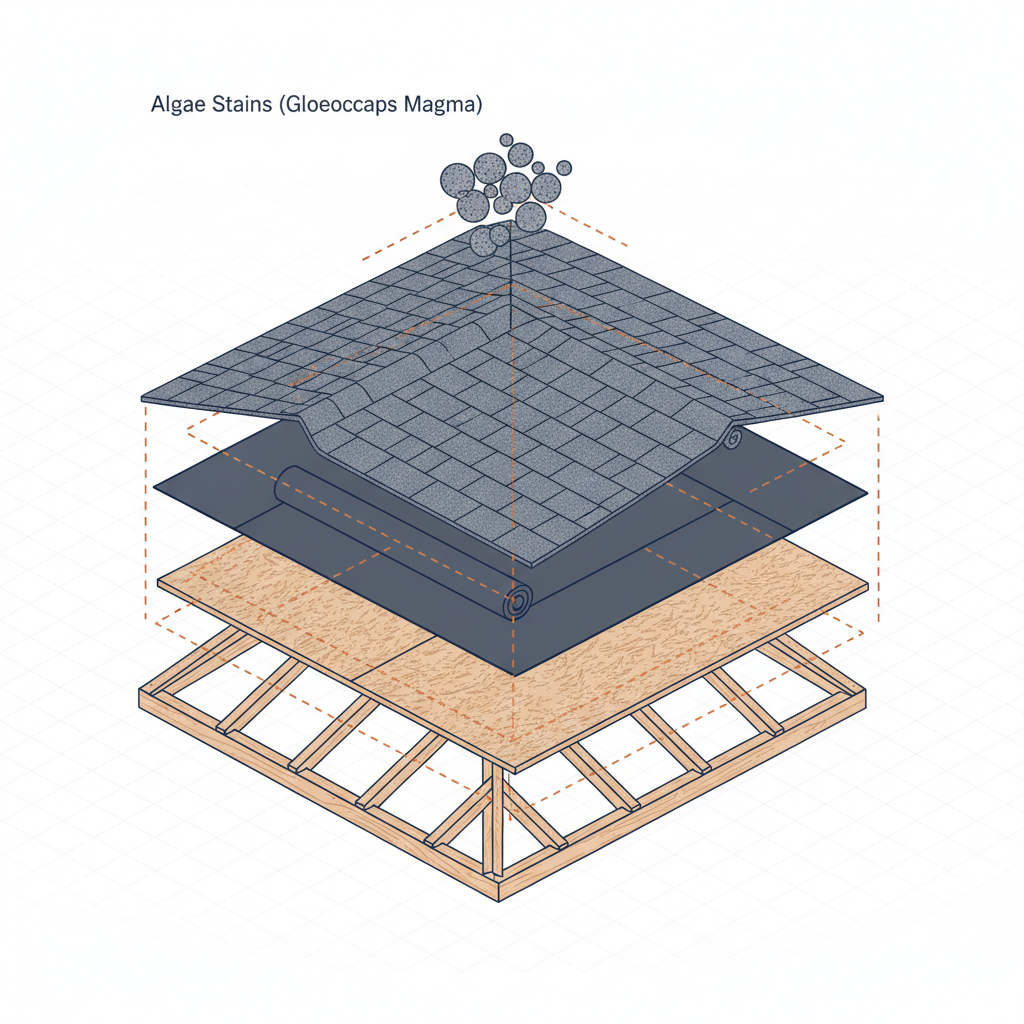
Gloeocapsa magma is a species of cyanobacteria that forms dark, filament-like growths on the top covering of buildings, most notably on asphalt roof shingles. These black streaks are often mistaken for mold, mildew, or soot, but they represent a distinct biological process that requires a specific diagnostic and remediation protocol. The presence of these stains directly challenges the primary function of a roof: to provide absolute protection against environmental elements like rain and sunlight. Understanding the distinction between a surface-level cosmetic problem and a threat to the roof system’s integrity is critical for asset preservation.
The standard roofing industry often presents homeowners with chaotic, reactive solutions. We reject that model. Our methodology is built on systematic diagnosis and predictable execution. This analysis is for the meticulous homeowner who values clarity and control over a low-bid, high-risk alternative. If your primary goal is securing the lowest price, we are not the right company for you. Our process is engineered for clients who understand that predictability is the most valuable commodity in any construction project.
Initial Assessment: A Systematic Diagnosis of Black Roof Stains
A correct diagnosis is the foundation of any effective solution. The black streaks on your roof are symptoms, not the root cause. A disciplined assessment identifies the specific agent causing the discoloration, which dictates the appropriate protocol. Misidentification leads to ineffective treatments, wasted investment, and potential damage to the roofing materials that are engineered to protect your home from wind and water.
Differentiating Algae Growth from Mold and Soot
Distinguishing between organic growths is the first critical step. Gloeocapsa magma, a blue-green algae, is the most common cause of black roof stains, particularly on north-facing slopes that receive less direct sunlight and retain moisture longer. It manifests as uniform, dark streaks. Mold, by contrast, typically appears as splotchy patches of green, brown, or black and often indicates a more severe, underlying moisture problem within the roof system. Soot is an environmental deposit, usually appearing as a powdery, localized stain near chimneys or industrial fallout zones.
| Stain Type | Identifier | Typical Location | Underlying Risk |
|---|---|---|---|
| Gloeocapsa Magma (Algae) | Dark, uniform streaks | North-facing slopes, shaded areas | Moisture retention, granule displacement |
| Mold/Mildew | Fuzzy, splotchy patches (green/black) | Areas of trapped moisture, under debris | Indicates potential roof deck rot |
| Soot/Pollutants | Powdery, localized discoloration | Near chimneys, vents, industrial zones | Primarily cosmetic, can be abrasive |
Analyzing Environmental Pollutants and Debris Stains
Non-biological factors can also discolor a roof. Environmental fallout, including soot from chimneys or industrial pollution, can settle on the roof surface. These stains differ from algae in texture and distribution. Similarly, decaying organic matter like leaves and pine needles can leave behind tannins that stain the shingles. While often cosmetic, this debris traps moisture, creating a habitat that promotes the growth of the very algae and mold you seek to prevent.
Investigating Material Degradation: Granule Loss and Bitumen Exposure
The most serious form of roof discoloration is not a stain at all, but rather evidence of material failure. Asphalt shingles are coated with ceramic granules that serve a critical function: they protect the underlying bitumen layer from UV radiation. When these granules are lost due to age, hail, or improper pressure washing, the black bitumen is exposed. This appears as dark patches or bald spots. This is not a cosmetic issue; it is a clear indicator that the shingle’s protective capability is compromised, signaling an imminent failure point in the roof system.
Risk Analysis: How Stains Compromise Your Roof’s Protective Function
A roof is a complete system engineered to provide a barrier against the environment. Its function is absolute: to protect the building from precipitation, solar radiation, and temperature extremes. Gloeocapsa magma and the moisture it retains introduce a variable that directly degrades this protective function over time. The risk is not immediate failure, but a systematic acceleration of the roof’s aging process.
Impact on Solar Reflectance and Temperature Regulation
Roof shingles, particularly lighter-colored ones, are designed to reflect a significant portion of solar radiation. This solar reflectance, or albedo, is a key component of your home’s thermal regulation. Dark algae stains effectively change the color of your roof to black, dramatically increasing heat absorption. This elevated surface temperature accelerates the breakdown of the shingle’s volatile chemical compounds, making them brittle. It also increases the heat load on your attic, forcing your HVAC system to work harder and increasing energy costs.
Moisture Retention’s Effect on Material Integrity
Gloeocapsa magma has a filamentous structure that acts like a sponge, trapping and holding moisture against the shingle surface long after a rain event has passed. This persistent dampness is the primary enemy of all roofing materials. It promotes the growth of more destructive organisms like mold and lichen, whose root-like structures can dislodge protective granules. Most critically, this constant moisture accelerates the slow, inevitable decay of the shingle and can, over many years, compromise the integrity of the underlying roof deck, which is the structural support of the entire roof system.
Aesthetic Degradation vs. Structural Concern: A Clear Distinction
For a meticulous homeowner, curb appeal and property value are valid concerns. The aesthetic degradation caused by algae is undeniable. However, it is a mistake to view this as a purely cosmetic issue. The presence of algae is a data point—an early warning signal. It indicates that the environmental conditions on your roof surface are favorable for organic growth and moisture retention. While the stains themselves are not a structural failure, they are a direct contributor to the conditions that cause long-term, systemic degradation. Ignoring the cosmetic symptom allows the underlying systemic risk to compound.
Systematic Remediation Protocols: Cleaning vs. Replacement
Once a diagnosis is confirmed, a clear, logical protocol for remediation is required. The choice between cleaning and replacement is not arbitrary; it is a calculated decision based on the age of the roof, the extent of the staining, and evidence of material degradation. The goal is not a temporary fix, but the restoration of the roof’s protective function for the maximum possible duration.
Chemical Cleaning: A Protocol for Safe Application
For a roof that is structurally sound but stained, a chemical cleaning process known as soft washing is the only acceptable method. This protocol involves the application of a precisely formulated solution, typically containing sodium hypochlorite, at very low pressure. The solution eliminates the biological growth without relying on destructive force. A professional protocol includes systematic protection for all landscaping, neutralizing runoff, and a thorough rinsing of the roof and surrounding property. This is a controlled chemical process, not a brute-force cleaning.
High-Pressure Washing: Why This Method Causes Irreparable Damage
Using a high-pressure washer on asphalt shingles is malpractice. The practice is common in the chaotic, low-bid sector of the industry because it is fast. It is also catastrophically destructive. The intense water pressure strips away the protective ceramic granules, exposing the bitumen to UV degradation and instantly voiding any manufacturer’s warranty. This action causes permanent, irreparable damage to the shingle, shortening the roof’s service life and creating a vector for water intrusion. The risk is absolute and unacceptable.
Decision Framework: When to Clean vs. When to Replace
A cost-benefit analysis dictates the correct course of action. This decision should not be emotional. It must be based on objective criteria.
| Factor | Recommendation: Clean | Recommendation: Replace |
|---|---|---|
| Roof Age | Under 12-15 years | Over 15 years or approaching end of warranty |
| Granule Loss | Minimal to none | Visible ‘bald’ spots, excessive granules in gutters |
| Shingle Condition | Flexible, intact, no curling | Brittle, curled, cracked, or missing shingles |
| Extent of Staining | Cosmetic staining covers less than 50% of surfaces | Heavy, uniform staining with moss/lichen growth |
Cleaning a roof that is near the end of its functional life is a poor allocation of resources. Conversely, replacing a young, healthy roof for cosmetic reasons is unnecessary. A systematic evaluation provides the data needed for a logical, long-term decision.
Proactive Engineering: Materials and Methods for a Stain-Free System
The most effective strategy is to engineer a roofing system that is inherently resistant to organic growth. For homeowners requiring a full roof replacement, material specification and system design are critical to preventing the recurrence of algae. This proactive approach focuses on building science principles to create an environment hostile to Gloeocapsa magma.
Specifying Algae-Resistant (AR) Shingles for New Installations
Modern materials science provides a direct solution. Algae-resistant (AR) shingles are manufactured with copper-infused granules. Copper is a natural biocide. As rainwater washes over the shingles, it leaches trace amounts of copper ions, which flow down the roof surface and inhibit algae growth. Specifying AR shingles from a reputable manufacturer is the single most effective method for ensuring a long-term, stain-free roof. The manufacturer’s warranty on algae resistance provides a quantifiable guarantee of performance.
The Role of Copper and Zinc Strips in Algae Mitigation
For existing roofs or as a supplemental measure, strips of copper or zinc can be installed at the roof’s ridge. Similar to AR technology, rainwater washes over the metal strips, carrying metallic ions down the roof to create a zone of algae inhibition. While this can be an effective retrofit, its effectiveness diminishes further down the roof slope. It is a valid preventative tactic, but less comprehensive than specifying shingles with integrated AR technology from the start.
Optimizing Roof Ventilation to Control Moisture and Organic Growth
Building science dictates that a roof must breathe. A balanced ventilation system, consisting of intake vents (at the soffits) and exhaust vents (at the ridge), constantly moves air through the attic space. This airflow serves two purposes: it removes super-heated air in the summer and, critically, it evacuates moisture year-round. A damp, stagnant roof surface is the ideal breeding ground for algae. Proper ventilation keeps the roof deck and shingles drier, fundamentally altering the environment to make it less hospitable for organic growth.
RocStout Roofing: A Predictable Process for Roof Integrity
We built our company as the antidote to the chaos of the typical roofing project. Your home is your most significant asset, and its primary defense system deserves a level of precision and project management that is rarely seen in this industry. Our process is transparent, methodical, and designed to eliminate surprises. It is the only sane way to manage a complex project that directly impacts your home’s structural integrity.
We conduct a complete forensic analysis of your entire roof system, from the deck to the ventilation. You receive a detailed written report with photographic evidence that identifies the root cause of any issue, not just the symptoms.
Based on our diagnosis, we deliver a detailed, line-item proposal with a fixed price. There are no hidden fees or surprise charges. The price we quote is the price you pay. This provides absolute financial predictability.
You are assigned a dedicated Project Manager who is your single point of contact. You receive daily updates, your property is kept meticulously clean, and we execute the scope of work with precision. The project is not complete until a final walkthrough confirms every detail meets our exacting standards.
This process-driven methodology ensures that every project is completed on time, on budget, and to a standard that protects the integrity of your home. It is a system built for homeowners who, like us, believe that chaos is the enemy.