A differential diagnosis between shingle blistering and hail damage is a forensic process of identifying the root cause of surface anomalies on an asphalt roof covering. Shingle blistering is a symptom of material failure, often linked to manufacturing defects or improper attic ventilation. Hail damage is the result of an acute impact event from a projectile. A correct identification is the primary factor in determining the appropriate resolution, from a manufacturer warranty claim to a homeowner’s insurance claim.
Initial Assessment: Differentiating Surface Anomalies on Your Roof Covering
The integrity of your roof depends on an accurate assessment of its condition. Surface anomalies like blisters and impact marks are not interchangeable; they signify entirely different problems with distinct solutions. For the meticulous homeowner, understanding this distinction is the first step in mitigating risk and protecting the structural envelope of your property.
Why a Correct Diagnosis is Non-Negotiable
A misdiagnosis between blistering and hail damage creates significant financial and structural risk. Submitting an insurance claim for blistering, which is a manufacturing or installation issue, results in an immediate denial and a permanent record on your policy. Conversely, failing to identify legitimate hail damage forfeits your right to a claim for a covered peril. An incorrect assessment compromises your warranty, devalues your property, and can lead to expensive repairs for issues that should have been covered by a third party. Precision is not optional; it is fundamental to asset protection.
The Flaw in the Standard ‘Quick Quote’ Roofing Process
The conventional roofing industry operates on speed and volume, not precision. The result is a chaotic process defined by vague estimates, ambiguous timelines, and a tolerance for diagnostic errors. This approach is unacceptable. A contractor who cannot definitively differentiate between a manufacturing defect and storm damage cannot be trusted to manage a complex project. Our philosophy is the antithesis of this chaos. We operate on a foundation of objective data and methodical analysis. If your primary goal is the lowest possible price, we are not the right fit. Our process is designed for homeowners who require certainty and a predictable outcome, free from the stress of hidden costs and unresolved issues.
Roof System Fundamentals: The Science of Protection
A roof is the top covering of a building, including all materials and constructions necessary to support it, providing protection against rain, snow, sunlight, extremes of temperature, and wind. It is not merely a cosmetic layer; it is an integrated system engineered for environmental defense. Understanding its core components is essential to diagnosing its failures.
Analyzing Shingle Composition: Granules, Bitumen, and Matting
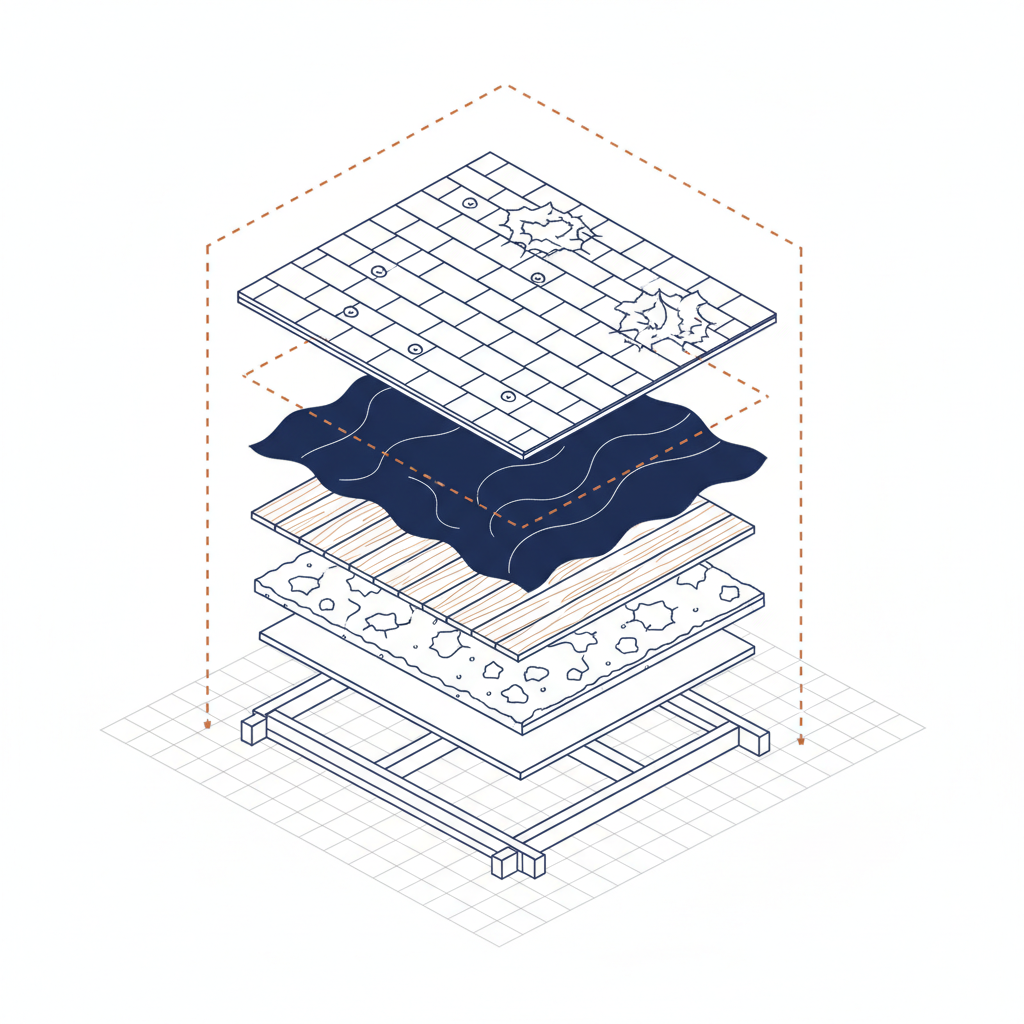
An architectural asphalt shingle is a composite material with three critical layers. The base is a fiberglass mat, which provides structural integrity and fire resistance. This mat is saturated and coated with bitumen (asphalt), the primary waterproofing agent. The top surface is embedded with a dense layer of ceramic-coated mineral granules. These granules serve a dual purpose: they provide UV protection to shield the bitumen from solar degradation and they add the shingle’s color.
Primary Function: Shielding Your Structure from Environmental Forces
The primary function of this composite shingle is to form a watertight, resilient barrier. It must withstand the blunt force of rain, deflect damaging solar radiation, and remain stable through cycles of extreme heat and cold. The integrity of each layer is codependent. The loss of granules exposes the bitumen, which then degrades rapidly, compromising the entire system’s ability to protect the building from water intrusion and other environmental forces.
Diagnostic Criteria for Shingle Blistering: A Manufacturing & Ventilation Issue
Shingle blistering is an internal failure of the shingle itself. It occurs when gases from moisture or solvents trapped within the shingle expand under heat, creating bubbles or ‘blisters’ on the surface. This is fundamentally a problem of material composition or environmental control, not external impact.
Visual Identification: Uniform ‘Pops’ with Intact Granules
Blisters appear as small, pimple-like bumps on the shingle’s surface. When these blisters ‘pop,’ they leave behind a small pit or crater. The key visual differentiator is that the edges of this pit will have granules intact, as the eruption came from beneath the surface. The pattern is often uniform or rash-like across sun-exposed roof slopes. The asphalt inside the popped blister will not be exposed or bruised; it will have a shiny, unweathered appearance.
Causal Analysis: Trapped Moisture vs. Inadequate Airflow
There are two primary causes of blistering. The first is a manufacturing defect where moisture is trapped within the shingle during production. The second, and more common, cause is inadequate attic ventilation. When an attic space is not properly ventilated, extreme heat builds up on the underside of the roof deck. This superheats the shingles, causing the volatiles in the asphalt to turn to gas and form blisters. This is a system failure, not just a shingle failure.
Impact on System Longevity and Protective Capability
While a few blisters may seem cosmetic, widespread blistering is a sign of premature aging. As blisters pop, the craters expose the bitumen to the elements, accelerating granule loss across the shingle. This erosion of the protective granule layer compromises the shingle’s water resistance and UV protection. The material degradation significantly shortens the effective lifespan of the entire roof system, turning a 30-year roof into a 15-year liability.
Diagnostic Criteria for Hail Damage: An Acute Impact Event
Hail damage is the direct result of a kinetic energy event. It is a physical trauma inflicted upon the shingle by a frozen projectile. Unlike blistering, which is a slow, internal process, hail damage is an instantaneous, external event.
Visual Identification: Random Patterns and Bruised Depressions
Hail impact marks are characterized by random patterns across the roof surface. A key visual indicator is a depression or dent where granules have been forcefully driven into the bitumen, exposing the underlying mat. This looks like a dark spot or ‘bruise’ on the shingle. The pattern of damage will be inconsistent, reflecting the chaotic nature of a hailstorm. There is no uniformity to the location, size, or shape of the impacts.
Tactile Assessment: Identifying Soft Spots in the Shingle Mat
A physical inspection is required for a definitive diagnosis. A true hail impact will feel soft or spongy to the touch, similar to a bruised piece of fruit. This ‘soft spot’ indicates that the impact has fractured the fiberglass mat beneath the surface. Blisters, by contrast, leave behind a hard, pitted surface with no underlying softness. This tactile feedback is a critical piece of forensic evidence that separates impact damage from blistering.
System-Wide Collateral Damage: Vents, Flashing, and Gutters
A hailstorm does not discriminate. A comprehensive inspection must include an assessment of the entire roof system. Hail will leave dents and dings on soft metal components like roof vents, exhaust caps, metal flashing, and gutters. The presence of this collateral damage is strong corroborating evidence of a hail event. The absence of any damage to these components when shingle anomalies are present points away from hail and toward another cause, like blistering.
Forensic Comparison Matrix: Blistering vs. Hail
A systematic comparison isolates the defining characteristics of each condition. This data-driven approach removes ambiguity and forms the basis of an accurate diagnosis.
| Attribute | Shingle Blistering | Hail Damage |
|---|---|---|
| Granule Loss Pattern | Minimal loss at the crest of the popped blister. Granules remain around the edge of the pit. Looks like a tiny crater. | Significant loss at the point of impact. Granules are pressed into the asphalt, exposing the matting. Looks like a dark bruise. |
| Surface Texture | Raised bumps or open pits. The underlying surface feels hard and rigid. | Indented depressions. The underlying surface feels soft and spongy, indicating a fractured mat. |
| Distribution Pattern | Often uniform, appearing like a rash, typically on slopes with the most direct sun exposure. | Completely random and inconsistent in size, shape, and location across all roof slopes. |
| Collateral Evidence | None. Soft metals (vents, flashing, gutters) will be undamaged. | Present. Soft metals will show corresponding dents, dings, and impacts. |
| Insurance Implications | Considered a manufacturer defect or installation/maintenance issue (poor ventilation). Excluded from insurance coverage. | Considered an ‘Act of God’ or covered peril under most homeowner policies. Qualifies for a claim. |
The Antidote to Chaos: A Methodical Process for Roof Damage Resolution
Identifying the problem is only the first step. The solution requires a process that is as methodical and precise as the diagnosis itself. We have engineered a workflow to eliminate the chaos and unpredictability that defines the standard roofing experience. Predictability is the objective.
We conduct a comprehensive assessment, capturing high-resolution photo and video evidence of every component. This is not a guess; it is a collection of objective data used to generate an accurate diagnosis and a digital forensic report.
We present you with the data from our inspection and a clear analysis. Whether it is a warranty claim, an insurance claim, or a repair, you receive a detailed scope of work with transparent, line-item pricing and a firm project timeline. There are no surprise charges.
A Note on Our Philosophy: We Prioritize Certainty Over Low Bids
Our process is intentionally meticulous. It is built for homeowners who manage their property like a business asset and cannot tolerate the risks of disorganization, poor communication, and ambiguity. We understand the anxiety that comes from a chaotic home renovation project. Our entire system is designed to eliminate it. This commitment to a higher standard of project management means we are not the cheapest option. If your selection criteria is based solely on finding the lowest price, we will not be the right partner for you. We are for the meticulous homeowner who understands that true long-term value lies in a predictable process and a guaranteed outcome.