Executive Summary: A Fiduciary’s Framework for Roof System Selection
The decision between a roof recover (roof-over) and a full system tear-off is a critical capital planning directive, directly influencing your building’s structural load, long-term liability, and total cost of ownership. For the fiduciary asset manager, this is not a choice between two construction methods; it is a calculated decision between accepting a known future liability for a short-term cash flow benefit versus investing in total risk abatement for predictable, long-term asset performance. The lowest bid, particularly one that advocates for an overlay without rigorous due diligence, is not a cost-saving measure—it is a financial liability that invites structural failure, operational disruption, and potential legal exposure.
Moving Beyond First-Cost: Evaluating Total Cost of Ownership (TCO)
A myopic focus on initial capital expenditure is the most common and costly error in commercial asset management. A comprehensive lifecycle cost analysis reveals a more accurate financial reality. Deferred maintenance, manifesting as trapped moisture and degraded insulation under a new roof recover, does not vanish. Instead, it transforms into a compounding financial burden, diminishing energy efficiency (increasing OpEx) and accelerating the deterioration of the structural deck. Our methodology replaces this gamble with a data-driven approach, evaluating the net present value (NPV) of a full replacement against the significant long-term liability of a potentially compromised recover project. We operate from a simple premise: a capital investment must either extend an asset’s useful life or reduce its operational cost. A roof-over that conceals underlying defects achieves neither.
The Core Decision Axis: Structural Load vs. Capital Outlay
At its core, the choice is governed by a fundamental engineering principle: the dead load capacity of your building’s structure. A roof-over adds a permanent, non-negotiable weight—typically 2 to 5 pounds per square foot (PSF)—to a structure that was engineered for a specific maximum load. While the initial investment for a recover is lower, it comes at the direct expense of your structural safety margin. Financial modeling must account for this transfer of risk. RocStout’s standard operating procedure mandates a thorough structural engineering review before any recommendation is made, ensuring every capital plan is built on a foundation of compliance, safety, and fiscal responsibility.
Structural Load Analysis: The Governing Principle in Commercial Roofing
The structural integrity of your facility is a non-negotiable asset. Before any discussion of roofing membranes or warranties, we must address the governing principle of structural load. Every commercial building is designed with a specific load capacity, a finite limit dictating the total weight the structure can safely support. This capacity is divided into ‘live loads’ (temporary forces like snow, rain, or maintenance crews) and ‘dead loads’ (the permanent, static weight of the building’s components, including the roof system itself). Exceeding this capacity is not a risk; it is a certainty for failure.
Calculating Dead Load: The Cumulative Weight of Roofing Assemblies
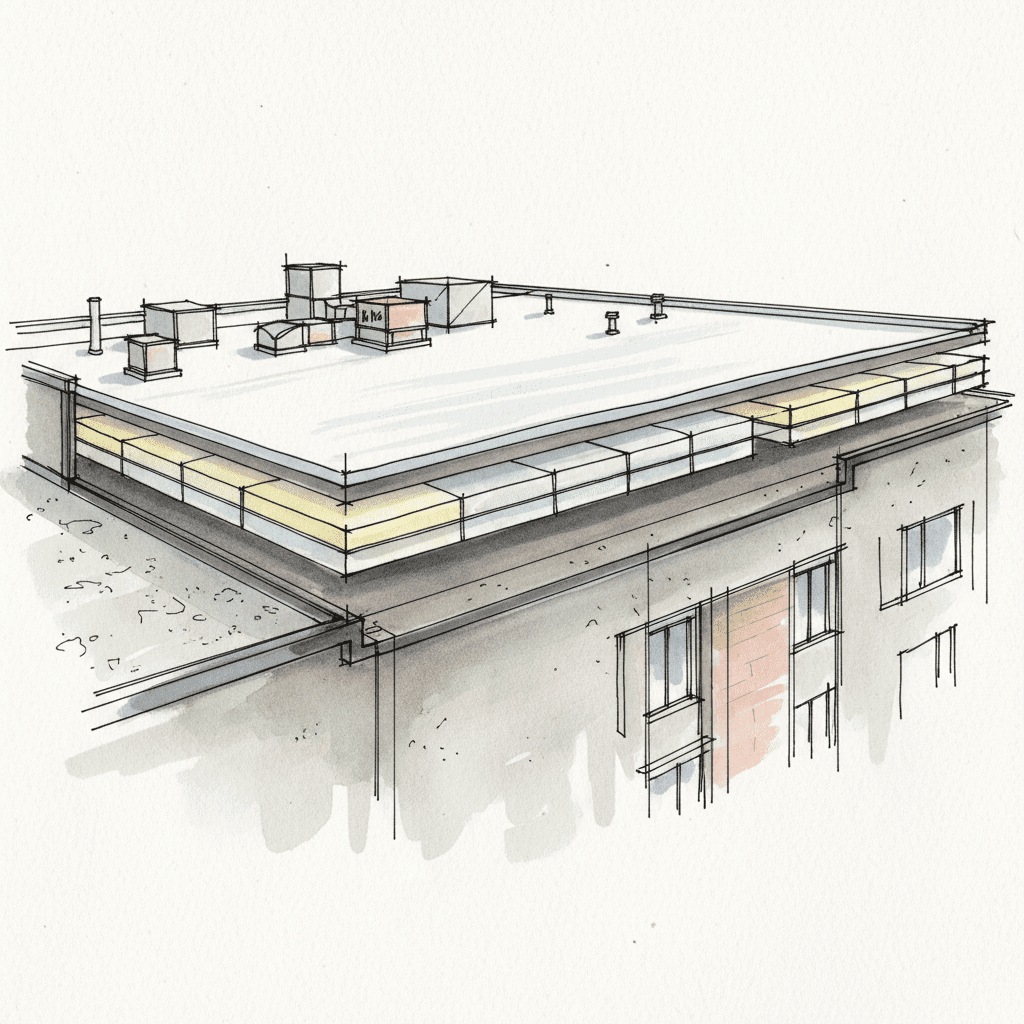
The dead load of a roofing system is the sum of its parts. This includes the membrane, insulation boards, cover boards, fasteners, adhesives, and any existing materials. A typical single-ply system may weigh 2-3 PSF. A built-up roof (BUR) with gravel ballast can easily exceed 10-15 PSF. When a contractor proposes a recover, they are proposing to add the full weight of the new assembly directly on top of the old one. This cumulative weight must be calculated and verified against the building’s original design specifications. Failure to perform this calculation is not just negligence; it is a willful disregard for structural engineering and occupant safety.
The Compounding Effect: How a Roof Recover Increases Dead Load
Adding a new roofing system directly over an existing one creates a compounding structural stress. This added weight is borne by every load-bearing component: the roof deck, the joists or trusses, the load-bearing walls, and ultimately the building’s foundation. In regions with seismic considerations or high snow load potential, this diminished safety margin introduces a critical vulnerability. A structure that was once compliant and safe can be pushed beyond its engineered limits, creating a risk of deflection (sagging) or, in the worst-case scenario, catastrophic failure. This is an uninsurable and indefensible position for any asset owner to hold.
Code Compliance Mandates: International Building Code (IBC) on Roof Layers
The decision is not solely a matter of engineering judgment; it is governed by law. The International Building Code (IBC), the standard adopted by most municipalities, explicitly limits the number of roof systems on a commercial structure. Section 1511.3 (2018 IBC) generally prohibits the installation of a new roof over two or more existing layers of roofing. Attempting to install a third roof system is a direct violation of building code, rendering permits invalid and exposing the property owner to significant legal and financial penalties. A contractor willing to bypass these permit requirements is not saving you money; they are selling you a non-compliant liability and jeopardizing your certificate of occupancy.
Risk Assessment: Uncovering Latent Liabilities in Existing Roof Systems
The most significant financial risks in commercial roofing are not visible from the surface. An existing roof system is an archive of performance data, containing critical information about moisture intrusion, substrate degradation, and thermal performance. A roof recover intentionally conceals this data, effectively entombing latent liabilities beneath a new membrane. This approach converts a manageable repair issue into a potential capital disaster.
When a new roof is installed over wet or saturated insulation, the moisture is trapped. This has immediate and severe financial consequences. Firstly, waterlogged insulation has a compromised R-value, leading to significant thermal bridging and energy loss. Your HVAC systems must work harder to maintain climate control, directly increasing your monthly operational expenditures. Secondly, this trapped moisture promotes mold proliferation and actively corrodes the metal or degrades the wood of your structural roof deck. This corrosion is a hidden ‘cancer’ on your asset, silently impairing its structural integrity and setting the stage for a far more expensive and disruptive replacement project in the future.
Why a Recover Can Mask, Not Mitigate, Critical Structural Issues
A recover provides a false sense of security. While it may temporarily stop new leaks, it does nothing to address the underlying causes of failure. Concealed damage, such as delaminated insulation, rotten wood decking, or corroded fasteners, remains in place. This creates a critical point of failure for the new roof system, as it cannot be properly anchored to a compromised substrate. This often leads to warranty nullification, as manufacturers’ NDL (No Dollar Limit) warranties are contingent upon installation over a sound, dry, and properly prepared surface. The short-term savings of a recover are quickly erased by the accelerated deterioration and the eventual necessity of tearing off *two* roof systems instead of one.
Financial Modeling: Comparing CapEx, OpEx, and Long-Term Asset Value
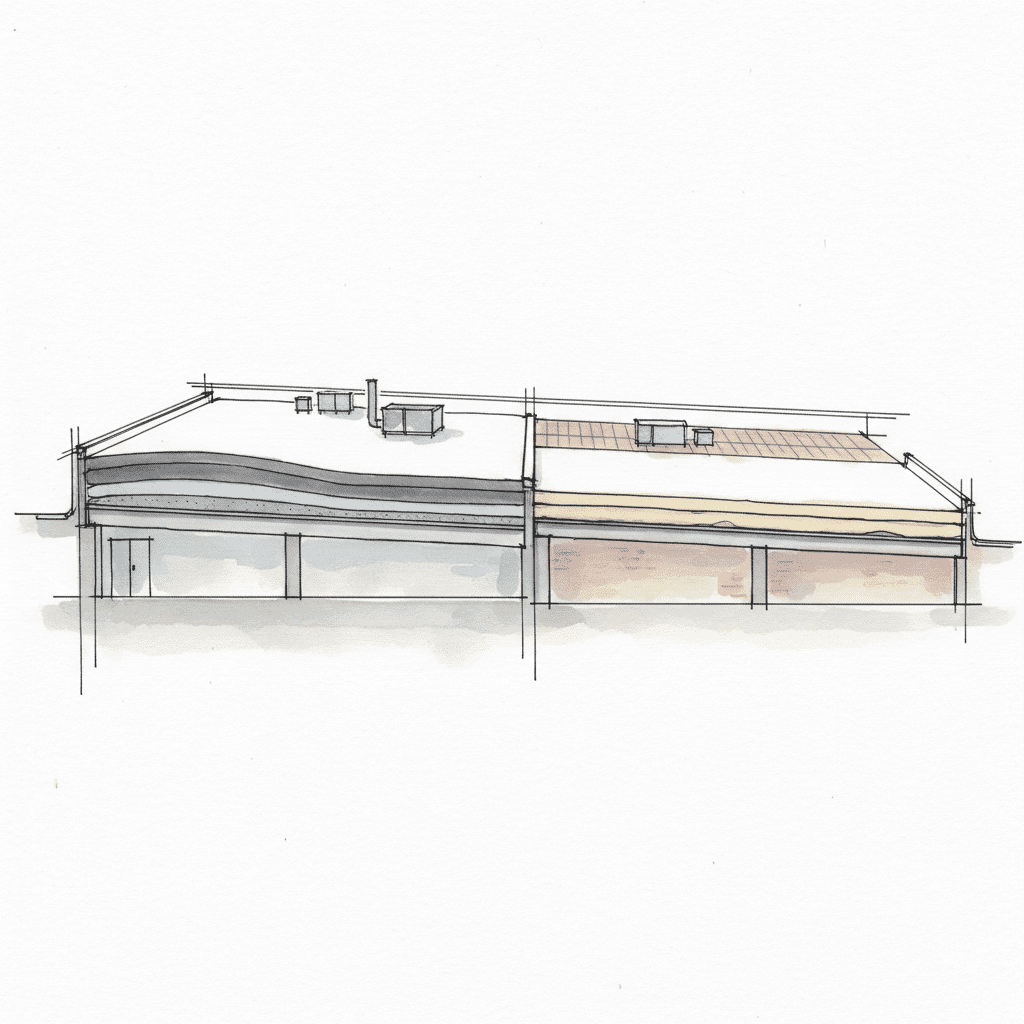
A responsible capital plan requires a clear-eyed comparison of competing investment scenarios. The decision to recover or replace a roof asset must be modeled based on initial CapEx, projected OpEx impacts, and the preservation of the asset’s long-term value. Below is a framework for this cost-benefit analysis.
| Financial Metric | Scenario 1: Roof Recover (Overlay) | Scenario 2: Full Tear-Off & Replacement |
|---|---|---|
| Initial CapEx | Lower initial cash outlay (40-60% of replacement cost). | Higher initial investment. |
| Structural Liability | Increases permanent dead load; conceals potential substrate decay; higher risk profile. | Resets dead load to original design spec; eliminates all latent structural risks. |
| Asset Lifespan | Shorter (10-15 years); performance is dependent on the condition of the underlying system. | Maximized (20-30+ years); performance is predictable and warrantable. |
| Energy Efficiency (OpEx) | Risk of trapping wet insulation, leading to compromised R-value and higher utility costs. | Opportunity to install new, dry insulation, maximizing R-value and reducing energy costs. |
| Manufacturer Warranty | Often limited or void if substrate issues arise. Excludes pre-existing conditions. | Eligible for comprehensive NDL (No Dollar Limit) warranties covering labor and materials. |
| Future Cost Liability | Guarantees the future cost of tearing off and disposing of two roof systems. | Eliminates future tear-off cost premium. Next replacement is a single layer. |
| Fiscal Certainty | Low. High potential for unforeseen change orders and premature failure. | High. Predictable performance and a fixed position on the depreciation schedule. |
Scenario 1: Roof Recover – Lower Initial Outlay vs. Higher Lifecycle Risk
Choosing a recover is a strategic decision to prioritize short-term cash preservation while knowingly accepting a higher-risk profile for the asset. This approach can be viable if, and only if, extensive due diligence confirms the existing roof is perfectly dry, well-adhered, and structurally sound. However, it requires a larger contingency budget for potential future failures and acknowledges that the eventual replacement will be more costly, involving the removal of two systems.
Scenario 2: Full Tear-Off – Higher CapEx for Total Risk Abatement
A full tear-off is an investment in total risk abatement and fiscal certainty. The higher initial CapEx removes all variables: the condition of the deck is verified, saturated insulation is eliminated, and the new system is installed on a clean substrate, ensuring maximum performance and full warranty compliance. This approach maximizes the asset’s lifespan, enhances energy efficiency, and provides a predictable, long-term capital expenditure that aligns with sound financial planning. It is the only methodology that guarantees the preservation of the capital asset.
The RocStout Diagnostic Protocol: Engineering for Fiscal Certainty
RocStout Commercial rejects the speculative approach common in the roofing industry. We operate as fiduciary partners, and our recommendations are based on a rigid, data-driven diagnostic protocol. This Standard Operating Procedure (SOP) is designed to eliminate ambiguity and provide you with the forensic analysis required to make a sound capital asset management decision.
Our process begins with data acquisition. Using infrared thermography and nuclear moisture gauges, we create a detailed map of your existing roof, identifying areas of potential moisture saturation without damaging the membrane. We then validate these findings with strategic core sampling to physically inspect the insulation’s integrity and the condition of the structural deck. This data-driven recommendation forms the basis of our analysis, replacing guesswork with verifiable facts.
If a recover is even a remote possibility based on the moisture survey, our next step is mandatory compliance verification. We engage our structural engineering partners to review as-built drawings and perform load calculations. This verifies the building’s capacity to accept the added dead load of a new system while maintaining all required safety factors. We do not proceed with any proposal until a licensed engineer confirms its compliance and structural viability.
The final deliverable is not a simple quote; it is a comprehensive, line-item capital plan. This document provides transparent pricing and a clear scope of work based on our forensic findings. It includes multi-year lifecycle planning and a risk-adjusted budget that empowers you to make an informed financial decision. With RocStout, there is no surprise billing. Our process is engineered to provide the fiscal certainty required for responsible capital asset management.