Vetting a commercial roofing contractor is a critical exercise in capital asset management, not merely a vendor procurement task. As a fiduciary responsible for the long-term financial performance and operational stability of a commercial property, your selection process directly impacts asset value, operational risk, and future capital expenditures. This due diligence checklist is engineered to move beyond superficial bids and assess a contractor’s capacity to function as a true fiduciary partner, one who safeguards your investment and guarantees fiscal certainty.
The Strategic Imperative: Viewing Contractor Selection as Capital Asset Preservation
Your commercial roof is a functional component of the building envelope and a significant financial asset on your balance sheet. Its performance directly influences operational costs, tenant satisfaction, and structural integrity. Therefore, selecting a contractor is not an expense to be minimized; it is an investment in risk management and the preservation of the asset’s total value. The standard industry approach of reactive repair and cost-centric bidding must be rejected in favor of a proactive, data-driven methodology aligned with your capital planning objectives.
The Financial Liability of the Lowest Bid: A Quantitative Analysis
Choosing the lowest bid for a commercial roofing project is one of the most significant financial liabilities a property owner or manager can assume. This decision often initiates a cascade of unforeseen costs that dwarf the initial savings. Low-bid contractors frequently subsidize their proposals by omitting critical scope details, using subpar materials, or carrying inadequate insurance. This leads directly to a series of predictable financial exposures: rampant change orders that inflate the final cost, premature system failure requiring a second full replacement years ahead of schedule, and the high probability of a voided manufacturer’s warranty. The most damaging costs, however, are often indirect: business interruption from leaks, damaged inventory, tenant disputes, and the potential for litigation stemming from safety lapses or property damage. A low bid is not a cost-saving measure; it is a transfer of risk directly onto your asset.
Defining Project Scope: Aligning Roofing Solutions with Long-Term Financial Goals
A responsible roofing project begins with a scope of work that aligns with your long-term capital expenditure (CapEx) strategy. A fiduciary advisor does not present a one-size-fits-all solution; we analyze the asset’s lifecycle, your holding period, and your financial goals to engineer the appropriate response. Is the objective to maximize energy efficiency and achieve a specific return on investment (ROI) through lower utility costs? Or is the primary goal to secure a 20-year NDL (No Dollar Limit) warranty to stabilize future maintenance budgets? The project’s technical specifications—from insulation R-value to membrane type and attachment method—must be a direct reflection of these financial objectives. We explicitly advise against solutions like overlays that conceal underlying deck or moisture issues, as they create unknowable and significant future CapEx liabilities.
Due Diligence Protocols: Mitigating Liability Through Credential Verification
Comprehensive due diligence is a non-negotiable protocol for mitigating the significant liabilities associated with construction. A contractor’s credentials are not formalities; they are the primary defense against financial loss, legal exposure, and operational chaos. This verification process must be systematic and unforgiving, as any deficiency represents a direct threat to your asset and your tenants.
Insurance Certificate Analysis: General Liability vs. Workers’ Compensation Adequacy
Requesting a Certificate of Insurance (COI) is standard practice, but analyzing its adequacy is a fiduciary duty. A standard $1 million general liability policy is grossly insufficient for most commercial projects. You must scrutinize the aggregate limits and demand proof of a substantial umbrella policy to protect against catastrophic events. Furthermore, verify that their workers’ compensation policy is current and covers roofing operations specifically—a classification with notoriously high premiums. An underinsured contractor exposes your organization to immense subcontractor liability. Any incident on your property involving their team could become your financial and legal burden. Our standard operating procedure requires all partners to meet stringent insurance thresholds that shield our clients from this risk.
| Credential | Standard Contractor (High Risk) | Fiduciary Partner (Risk Mitigation) |
|---|---|---|
| General Liability | $1M Occurrence / $2M Aggregate | $2M Occurrence / $4M Aggregate (Minimum) |
| Umbrella/Excess Liability | None or $1M | $5M – $10M+ (Project Dependent) |
| Workers’ Compensation | State minimums, potential gaps | Statutory limits with specific roofing classification |
| Bonding Capacity | Limited or unverified | Verified capacity exceeding project value |
Assessing Bonding Capacity to Guarantee Project Completion and Financial Security
A surety bond is a guarantee from a third party that the contractor will fulfill their contractual obligations. There are two critical instruments: a performance bond, which ensures the project is completed to specification, and a payment bond, which ensures all subcontractors and suppliers are paid. Demanding that a contractor be bonded is an essential stress test of their financial stability and operational integrity. A contractor with a significant bonding capacity has been thoroughly underwritten by a surety company, which has scrutinized their financial health, project history, and overall business practices. This is a powerful, independent validation of their ability to perform.
Verifying Safety Records: OSHA Compliance and EMR (Experience Modification Rate)
A contractor’s safety record is a direct reflection of their professionalism and a leading indicator of potential project disruptions. The two key metrics are their OSHA incident logs and their Experience Modification Rate (EMR). The EMR is a number used by insurance companies to gauge past cost of injuries and future chances of risk. An EMR of 1.0 is the industry average. A rate significantly above 1.0 indicates a poor safety record and higher insurance costs—costs that are often passed on through higher bids or cut corners. A rate below 1.0 demonstrates a commitment to safety that translates to fewer delays, lower liability risk for the property owner, and a more disciplined, professional operation on your property.
Technical Proficiency Assessment: Vetting Engineering and Installation Competence
A contractor’s financial and safety credentials must be matched by their engineering and technical competence. The long-term performance of your roofing asset is wholly dependent on the quality of installation and adherence to precise technical specifications. A failure in this domain results in premature degradation, chronic leaks, and a voided manufacturer warranty, erasing the value of your capital investment.
Evaluating Expertise in Commercial Roofing Systems (TPO, PVC, EPDM, Modified Bitumen)
Different commercial properties require different roofing systems based on factors like chemical exposure, foot traffic, UV intensity, and structural load. A proficient contractor must demonstrate deep, verifiable expertise not just in one system, but in the system best suited for your asset’s specific operational environment. Your vetting should include questions about their experience with TPO, PVC, EPDM, and Modified Bitumen systems. Ask for specific examples of projects where they recommended one system over another and the engineering rationale behind that decision. This distinguishes a true consultant from a simple installer.
The Critical Role of Manufacturer Certifications in Warranty Compliance
A manufacturer’s warranty (especially a No Dollar Limit warranty) is one of the most valuable outcomes of a roofing project, providing long-term financial protection. However, these warranties are contingent upon installation by a certified and approved applicator who follows the manufacturer’s material specifications to the letter. Failure to do so—using non-approved fasteners, incorrect weld temperatures, or improper flashing details—immediately voids the warranty. You must demand proof of current certification from the specific manufacturer whose products will be used. This certification is your only assurance that the work will be eligible for the warranty coverage you are paying for.
Reviewing Past Performance: Case Studies and Project Portfolio Analysis
Past performance is the most reliable predictor of future results. Move beyond a simple list of client references and request detailed case studies for projects of similar scope and complexity. Analyze their portfolio for work on occupied buildings, facilities with sensitive operations (e.g., data centers, cold storage), or complex architectural features. When contacting references, ask specific questions about their adherence to schedule, communication protocols, site cleanliness, and how they managed unforeseen challenges. This provides a clear picture of their real-world operational discipline.
Operational Excellence: Minimizing Tenant Disruption and Upholding Schedules
For any asset manager, the enemy is operational disruption. The true cost of a poorly managed construction project is measured in tenant complaints, interrupted business, and safety hazards. A premier commercial roofing partner understands that their primary role is to execute the project with zero negative impact on the building’s occupants and core business functions. This requires a rigorous, process-driven approach to project management, logistics, and communication.
RocStout’s Zero-Disruption Protocol
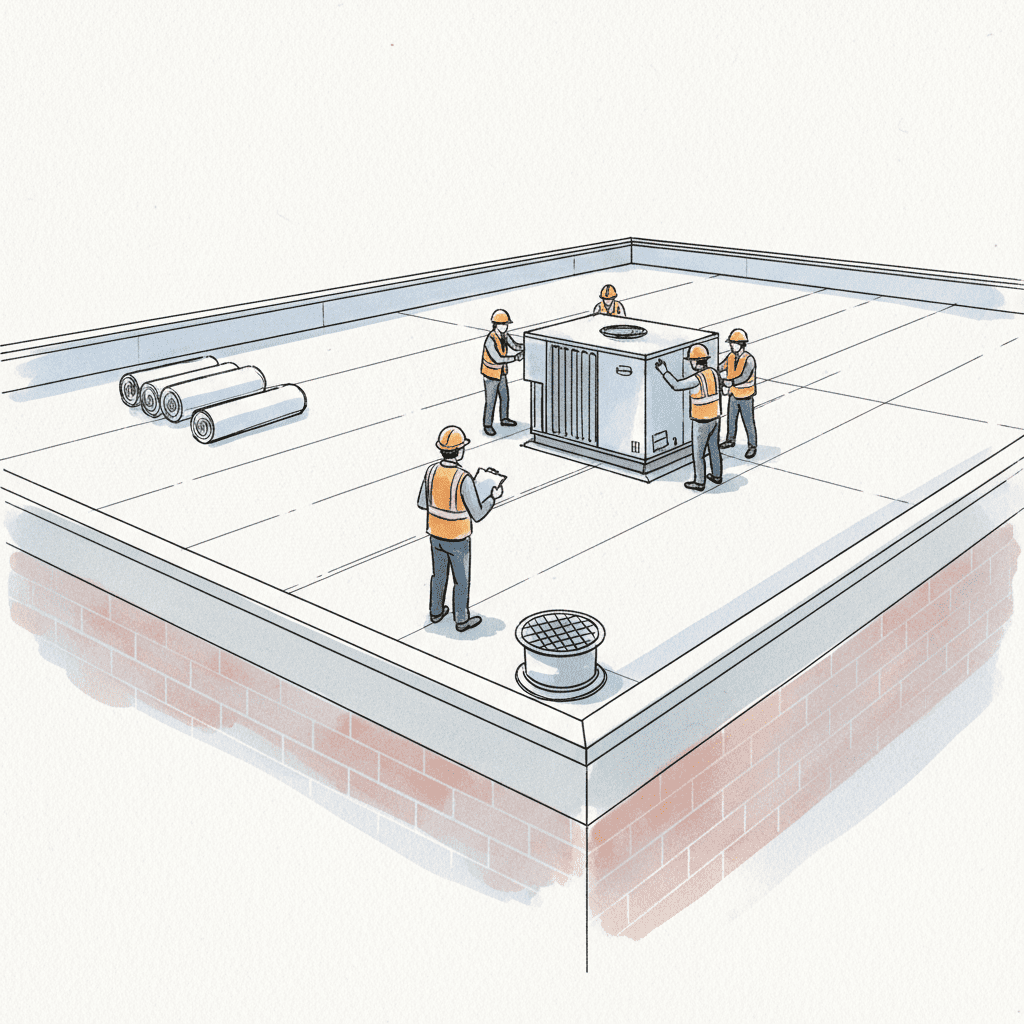
Establish clear staging areas, access routes, and work hours. Distribute a comprehensive communication plan to all tenants outlining the schedule and safety protocols.
Conduct daily safety meetings and provide daily progress reports to facility management. Maintain strict “water-tight-by-nightfall” protocols to protect the interior.
Debris is removed from the roof and site daily, not stockpiled. Public access ways are kept clear and clean at all times to ensure tenant safety and satisfaction.
Coordinate the manufacturer’s final inspection to verify compliance and formally activate the warranty, delivering all closeout documents to the client.
Scrutinizing the Project Management and Communication Plan
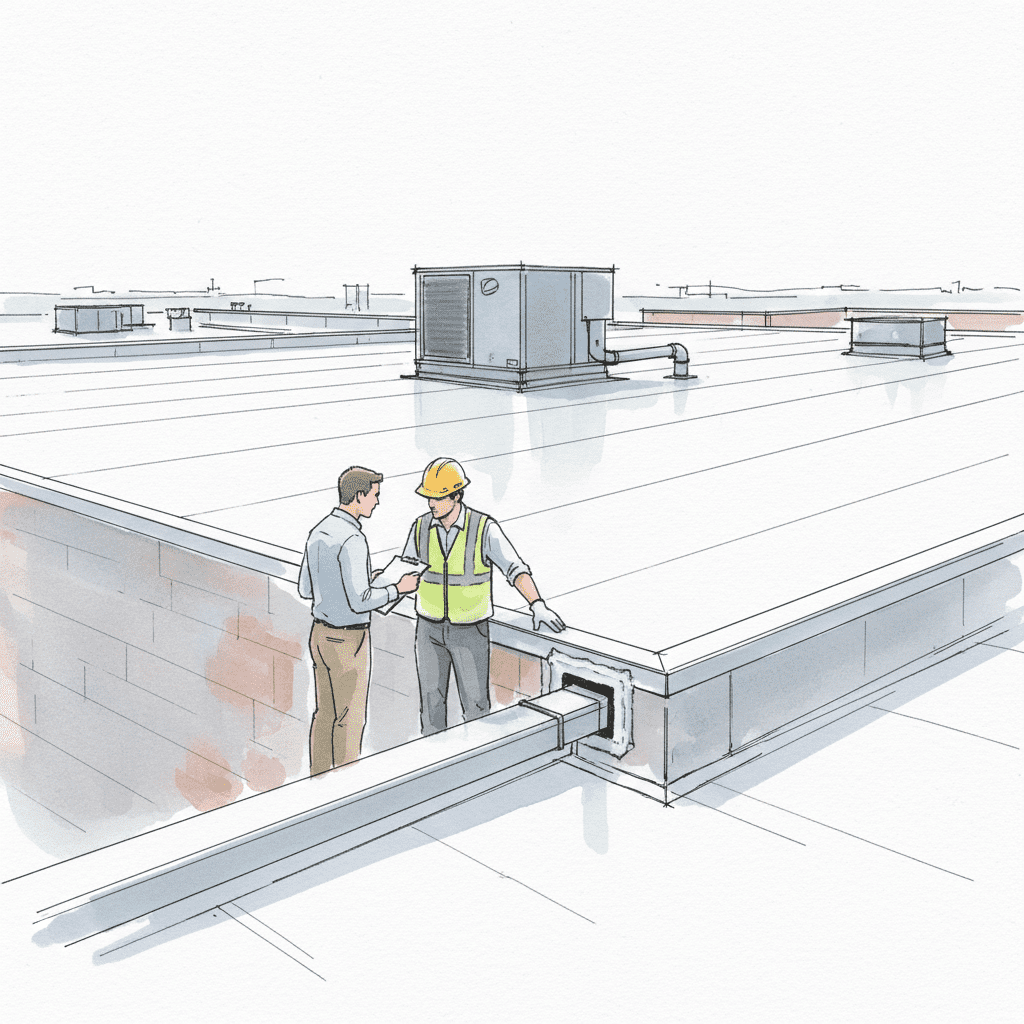
Demand to see a contractor’s project management and communication plan before signing a contract. This document should name the dedicated project manager, outline the protocol for daily reporting, and provide a detailed project schedule (e.g., a Gantt chart). It should clearly state how and when they will communicate with your facility management team and tenants. A lack of a formal, documented plan is a clear signal of a reactive, disorganized operation that will inevitably lead to delays and conflict.
Logistics and Site Safety Protocols for Occupied Buildings
Executing a roofing project on an occupied building requires a level of planning and discipline far beyond that of new construction. Your due diligence must include a review of their specific logistics plan. Where will materials be staged? What are the designated routes for equipment and debris removal to minimize impact on traffic and pedestrian flow? What measures are in place to prevent falling debris? These are not minor details; they are core components of a professional operation designed to protect your tenants and property.
Contingency Planning for Weather Delays and Unforeseen Conditions
Every construction project faces potential delays. A professional contractor anticipates them. Ask to see their contingency plans for adverse weather. How do they adjust schedules to account for rain or high winds while still ensuring the building remains watertight? How do they manage supply chain disruptions? What is their standard operating procedure upon discovering unforeseen structural deck rot or moisture contamination? Their answers will reveal whether they are a proactive partner who manages risk or a reactive contractor who creates it.
The RocStout Mandate: A Standard Operating Procedure for Fiscal Certainty
At RocStout, we operate under the mandate that commercial roofing is a matter of capital planning and asset management. We have engineered our entire process to deliver the one thing that asset managers require above all else: fiscal certainty. We do not compete on price; we compete on predictable outcomes, operational continuity, and the long-term preservation of your asset’s value. Our methodology serves as the benchmark against which all other contractors should be measured.
Our Contractor Vetting Matrix: A Data-Driven Qualification Process
The principles outlined in this document are not just advice; they are the foundation of our internal, data-driven qualification process. We assess every project through a vetting matrix that scores key performance indicators across financial health, insurance adequacy, safety metrics (EMR), manufacturer certifications, and documented project management systems. This ensures that only partners who align with our fiduciary standards are ever engaged on a client’s property.
Line-Item Reporting and ‘No Surprise’ Billing for Predictable CapEx
Your capital budget requires precision. That is why our proposals are built on a foundation of transparent, line-item reporting. You will see a detailed breakdown of costs for materials, labor, general conditions, and warranty procurement. We eliminate the ambiguity of lump-sum bids that hide contingencies and create grounds for change orders. Our ‘No Surprise’ billing philosophy means the price we agree upon is the price you pay. This allows you to plan your capital expenditures with confidence and avoid the budget overruns common in the industry.
Partnering in Multi-Year Lifecycle Planning to Maximize Asset Value
A roofing project is not the end of our engagement; it is the beginning of a long-term partnership in asset management. Upon project completion, we deliver a comprehensive lifecycle cost analysis and a proactive preventative maintenance plan. This strategy is designed to maximize the performance and lifespan of your new roof, turning a capital expense into a high-performing asset. By forecasting future maintenance needs and scheduling proactive inspections, we help you transition from a reactive repair cycle to a predictable, planned asset management model that maximizes your return on investment.