The Financial Imperative of Vapor Control in Commercial Roof Assemblies
A commercial roofing vapor barrier is an engineered component designed to prevent interior-generated moisture from compromising the structural integrity and thermal performance of the roof assembly, thereby protecting the building as a capital asset. For facilities with specific high-humidity operations, its inclusion is not an optional upgrade; it is a fundamental requirement for risk management. Failure to correctly assess the need for, and properly install, a vapor barrier exposes the asset to premature failure, unbudgeted capital expenditures, and significant operational liabilities.
Choosing the lowest bid for a commercial roofing project, especially one that omits or improperly specifies a vapor barrier, is a direct assumption of financial liability. It is a decision that invites inventory damage, tenant disruption, and potential litigation. RocStout operates as a fiduciary advisor, engineering roofing systems for long-term asset preservation, not short-term cost savings. Our process mitigates the risks of moisture infiltration that less disciplined contractors routinely ignore.
Quantifying the Financial Impact of Uncontrolled Condensation
Uncontrolled condensation within a roof assembly is a hidden liability that silently erodes asset value. When warm, moist interior air migrates into a colder roof assembly, it reaches its dew point and condenses into liquid water. This trapped moisture initiates a cascade of financial consequences, including accelerated structural corrosion of steel decks, degradation of fasteners, and the proliferation of mold, which introduces significant health liabilities and remediation costs. The most immediate impact is a sharp increase in operational costs due to energy loss as insulation becomes saturated.
Protecting Insulation Performance and Long-Term Energy Efficiency
Insulation’s thermal resistance, or R-value, is contingent on it remaining dry. Moisture saturation negates its effectiveness; a mere 1% moisture content by volume in common insulation materials can reduce R-value by over 35%. This degradation translates directly to higher HVAC operational expenditures and undermines the projected payback period of the roofing investment. A properly specified and installed vapor barrier is the primary defense mechanism that ensures the insulation performs to its engineered specification for the entire lifecycle of the roof, safeguarding your energy budget.
Vapor Diffusion vs. Air Leakage: A Critical Distinction for System Design
Managing moisture requires a precise understanding of two distinct transport mechanisms. Vapor diffusion is the slow movement of water vapor molecules through a material, driven by a difference in vapor pressure. Air leakage, however, is the movement of bulk air (carrying large amounts of water vapor) through gaps, cracks, and unsealed joints in the building envelope. Air leakage can transport hundreds of times more moisture than diffusion. While a vapor barrier primarily controls diffusion, its continuity and integration with the building’s air barrier system are critical. A comprehensive energy audit and system design must address both factors to create a truly resilient building envelope and prevent costly moisture-related failures.
Vapor Barrier Requirement Analysis: A Risk Management Protocol
The determination of whether a vapor barrier is required is not a matter of opinion or contractor preference. It is an engineering calculation based on a systematic analysis of climate, building operations, and material science. RocStout’s standard protocol is grounded in ASHRAE 160 standards for hygrothermal analysis, ensuring that capital is deployed only when necessary and specified to perform correctly. This data-driven approach removes guesswork and provides the fiscal certainty required for responsible asset management.
Climate Zone and Exterior Conditions: A Data-Driven Assessment
A facility located in a cold climate (e.g., IECC Zone 5 or higher) faces a significant risk of wintertime condensation. The large temperature differential between the heated interior and the cold exterior creates a strong vapor drive outwards. Our analysis begins with local climate data to determine the winter design temperature, which dictates the potential for dew point formation within the roof assembly. This establishes a baseline risk profile and informs compliance with stringent local energy code requirements for vapor control.
Evaluating Interior Operations and Humidity Generation
The primary driver for a vapor barrier is high interior humidity. Standard office buildings (30-50% RH) may not require one in moderate climates. However, facilities with manufacturing processes, commercial kitchens, swimming pools, data centers, or high-density occupancy generate substantial interior moisture loads. For these assets, a vapor barrier is non-negotiable. Our assessment quantifies the interior relative humidity (RH) to engineer a system with the appropriate level of vapor resistance, preventing moisture from reaching the dew point within the insulation or at the underside of the roof membrane.
Substrate Analysis: The Role of Concrete vs. Steel Decks
The type of roof deck is a critical variable. Freshly poured structural or lightweight concrete can take months or even years to fully cure, releasing a significant amount of moisture into the roof assembly from below. Installing a roofing system over a high-moisture concrete deck without a vapor barrier traps this moisture, leading to insulation saturation and potential blistering of the membrane. Conversely, steel decks are impermeable but susceptible to corrosion if condensation forms on their underside. Our substrate analysis and moisture testing protocols ensure the correct vapor barrier strategy is employed, preventing substrate-driven failure.
System Specification: A Comparative Analysis of Vapor Barrier Materials
Specifying a vapor barrier requires a technical analysis of its vapor permeance, measured in “perms” according to ASTM E96. A lower perm rating indicates higher resistance to water vapor transmission. The selection is not arbitrary; it must be compatible with the other roofing components and appropriate for the calculated moisture load. We do not offer a one-size-fits-all solution; we engineer the system for the specific performance and risk profile of your asset.
| Material System | Perm Rating (Typical) | Key Performance Attribute | Primary Application |
|---|---|---|---|
| Bituminous / Mod-Bit | < 0.01 Perms | Exceptional durability and puncture resistance. | High-traffic roofs, concrete decks, demanding environments. |
| Self-Adhered Membranes | 0.05 – 0.1 Perms | Controlled installation thickness, excellent seam integrity. | Steel and concrete decks where open flames are prohibited. |
| Polyethylene Film | < 0.1 Perms | Cost-effective for large, simple roof areas. | Mechanically fastened systems over steel decks; not for adhered systems. |
| Fluid-Applied Membranes | Variable (<0.5 Perms) | Monolithic, seamless protection for complex geometries. | Roofs with numerous penetrations; direct-to-deck applications. |
Bituminous and Asphalt-Based Systems: Performance and Longevity
Modified bitumen and multi-ply asphaltic systems offer the lowest perm ratings available, making them true vapor retarders. Their robust thickness provides superior durability and resistance to damage during construction. Whether torch-applied, cold-applied, or self-adhered, these systems provide a track record of long-term performance, making them the standard specification for mission-critical facilities where vapor control failure is not an option.
Polyethylene and Thermoplastic Membranes: Seam Integrity and Installation
Polyethylene films are a common material choice, but their performance is entirely dependent on the integrity of their seams. Every lap must be meticulously taped and sealed to prevent air and moisture leakage. While cost-effective, these systems have low puncture resistance and require disciplined sequencing to prevent damage before the subsequent roofing layers are installed. Self-adhered thermoplastic membranes offer a significant upgrade in quality control, providing factory-controlled thickness and superior adhesion.
Fluid-Applied Membranes: Monolithic Protection and Application Protocols
For roofs with complex geometries and numerous penetrations, fluid-applied membranes provide a distinct advantage. When installed according to strict manufacturer protocols regarding substrate preparation, primer application, and mil thickness, they form a seamless, monolithic barrier that eliminates seams—the most common point of failure. Curing time and environmental conditions during application are critical variables that must be managed by a certified installer to ensure proper performance.
Installation Integrity: Mitigating Workmanship-Related Financial Liabilities
The most expertly engineered vapor barrier specification is rendered useless by improper installation. Seam failures, poor penetration detailing, and delamination are not material defects; they are workmanship errors that create latent defects and long-term financial liabilities for the asset owner. RocStout mitigates this risk through rigid adherence to our Standard Operating Procedures for quality assurance, which are designed to eliminate installation error and the operational disruption it causes.
Standard Operating Procedures for Seam and Penetration Detailing
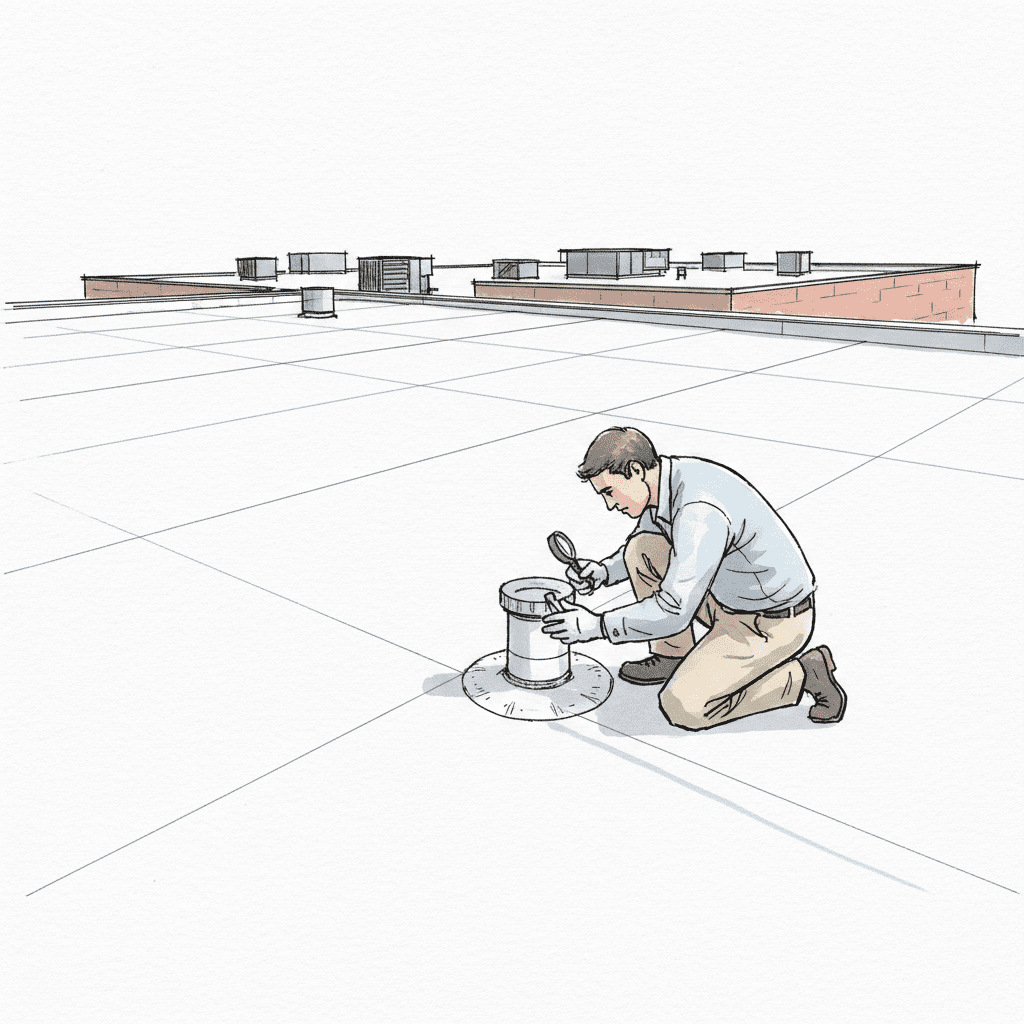
A vapor barrier is only as effective as its weakest point. Our installation protocol mandates complete continuity. This involves meticulous flashing and sealant application at all penetrations—pipes, curbs, and drains—and ensuring the vapor barrier is properly tied into the wall’s air/vapor barrier system. We enforce reverse lap shingling and manufacturer-mandated overlap widths to guarantee a water- and air-tight seal, verified through a multi-point quality control inspection before any subsequent layers are installed.
Adhesion and Substrate Preparation Protocols to Prevent Delamination
Proper adhesion is critical, particularly for self-adhered and fluid-applied systems. Our process begins with a documented substrate inspection to ensure the deck is clean, dry, and free of contaminants that can inhibit bond strength. We conduct bond strength tests as required and apply specified primers to ensure full, irreversible adhesion. This methodical preparation prevents delamination, a costly failure that can compromise the entire roofing assembly.
Project Sequencing to Minimize Operational Disruption and Tenant Impact
Our commitment to zero operational disruption extends to every layer of the roof. We understand that your facility must remain operational and your tenants undisturbed. Our project management team develops a detailed logistics and sequencing plan, including a tenant communication schedule, to ensure our work proceeds without impacting your core business. Adherence to strict OSHA compliance and our ‘water-tight-by-nightfall’ protocol are non-negotiable standards that protect your people, your inventory, and your revenue stream throughout the project.
RocStout’s Engineered Approach to Vapor Barrier Integration
RocStout does not install roofing materials; we manage a critical financial asset. Our engineered approach to vapor barrier integration is a component of a larger strategy focused on providing fiscal certainty and preserving capital asset value. We reject the reactive, low-bid model that plagues the commercial contracting industry in favor of a proactive, data-driven partnership that aligns with your financial objectives.
Initial Forensic Analysis and Hygrothermal Modeling for Fiscal Certainty
Our process begins with a forensic assessment, including core sampling and non-destructive testing, to understand the existing assembly’s condition. For facilities with high-humidity risk, we utilize WUFI or similar hygrothermal modeling software to simulate vapor drive and condensation potential under local climate conditions. This analysis forms the basis of an engineering report and design specification that justifies the capital expenditure and ensures the proposed system will perform as intended, providing absolute fiscal certainty before the project begins.
Process-Driven Project Management for Zero Operational Disruption
Every RocStout project is managed by a dedicated Project Manager who serves as your single point of contact. You receive daily reports detailing progress, safety compliance, and upcoming activities. Our tenant notification plan and rigorous schedule adherence are designed to make the roofing process invisible to your building’s occupants. This process-driven methodology is the antidote to the chaos and operational disruption caused by standard contractors.
Integrating Vapor Control into Multi-Year CapEx Planning
A roofing project should not be an unexpected financial shock. We work with facility managers and CFOs to integrate vapor control and other roofing needs into a proactive, multi-year capital expenditure plan. By analyzing the total cost of ownership, including energy savings and preventive maintenance, we transform a reactive repair into a predictable, planned investment. Our commitment to transparent, line-item reporting and ‘No Surprise’ billing makes us a trusted partner in your long-term asset management strategy.