Ponding water on a commercial roof is a clear indicator of drainage issues, posing a significant financial risk through accelerated membrane degradation, potential leaks, and structural strain. Ensuring positive drainage is critical for compliance and long-term roof asset protection.
Ponding Water Defined: Differentiating Between Nuisance and Financial Liability
As a fiduciary advisor, our role is to translate engineering standards into clear business logic. The presence of standing water on a low-slope roof is a critical data point about the health of your asset. The distinction between a temporary puddle and a chronic, damaging condition is defined by clear, industry-accepted metrics.
The 48-Hour Rule: The Engineering Standard for Water Accumulation
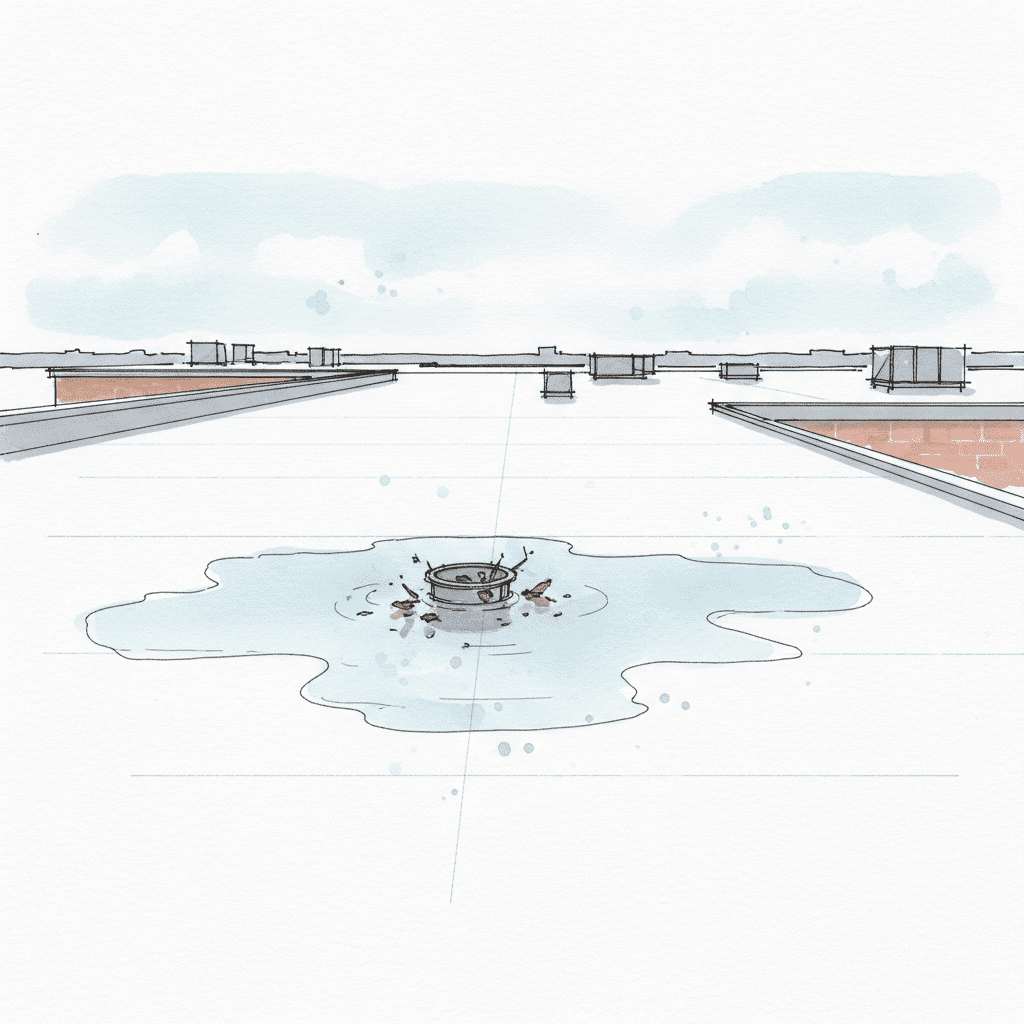
The National Roofing Contractors Association (NRCA) provides an unambiguous standard: water that remains on a roof surface 48 hours after a precipitation event is officially defined as ponding water. This is the engineering line in the sand. Water that evaporates or drains within this timeframe is expected. Water that persists signifies a failure of the roof’s design to achieve positive drainage. This failure is a direct precursor to water ingress, material degradation, and ultimately, a compromise of the entire roofing system.
Calculating Water Weight: Quantifying the Risk to Structural Integrity
The most immediate risk of ponding water is the imposition of a significant dead load that your building’s structure was likely not designed to support. Water is deceptively heavy, weighing 5.2 pounds per square foot (PSF) for every inch of depth. A seemingly minor area of ponding water can quickly exceed the load capacity of roof joists and decking, leading to structural deflection, which in turn creates a larger, deeper pond—a cycle that can culminate in a roof collapse. This is not a theoretical risk; it is a calculable liability.
| Water Depth | Weight per Square Foot (PSF) | Total Load over a 20’x20′ Area (lbs) | Financial Implication |
|---|---|---|---|
| 1 Inch | 5.2 PSF | 2,080 lbs | Exceeds design load for many non-primary structural members. |
| 3 Inches | 15.6 PSF | 6,240 lbs | Equivalent to parking three sedans on your roof deck. |
| 6 Inches | 31.2 PSF | 12,480 lbs | Critical structural risk; approaches total failure conditions. |
Impact on Asset Longevity and Manufacturer Warranty Compliance
Beyond the immediate structural threat, ponding water initiates a chemical and physical assault on the roof membrane. It magnifies UV radiation, accelerates the breakdown of protective coatings, and promotes the growth of vegetation whose roots can penetrate the membrane. Most critically for a CFO or asset manager, nearly every commercial roof manufacturer warranty explicitly excludes damage resulting from or exacerbated by ponding water. By allowing water to pond, you are effectively voiding the primary financial guarantee on your multi-million dollar roofing asset. The cost of subsequent roof leaks and repairs shifts from the manufacturer to your balance sheet.
Root Cause Analysis: Causal Factors of Commercial Roof Ponding
Effective mitigation requires a precise diagnosis. Ponding water is a symptom of a deeper systemic failure. Our forensic approach identifies the root cause to engineer a permanent solution, rather than applying a temporary patch that masks the underlying liability.
Design & Engineering Deficiencies: Inadequate Slope and Drainage Systems
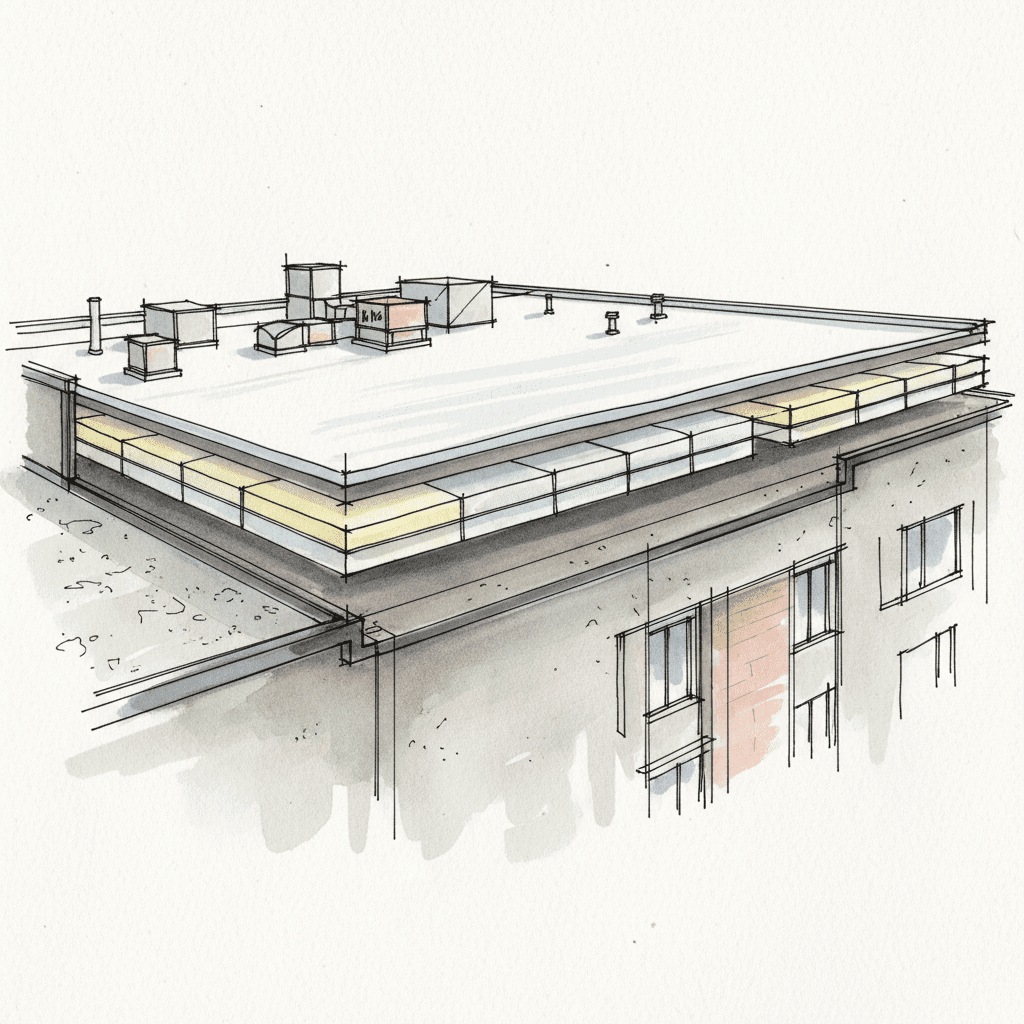
The most common cause of ponding water is a failure in the original architectural design. While building codes mandate a minimum slope (typically 1/4″ per foot), this is often inadequate when factoring in structural deflection and construction tolerances. A properly engineered system utilizes tapered insulation to create positive slope, directing water toward strategically placed internal drains and roof scuppers. Insufficient drainage capacity—too few drains for the roof area—is another common design flaw that guarantees system overload during heavy rainfall.
Structural Deflection: Identifying Compromised Decking and Supports
Over time, a building’s structural components can settle, sag, or fatigue. Support beams and roof joists may deflect under load, creating low spots in the roof deck where water naturally accumulates. This is a particularly insidious problem because it is self-perpetuating: the initial ponding adds weight, which causes further deflection, which allows more water to pond. This is precisely why RocStout’s standard operating procedure advises against roof overlays. An overlay conceals this critical structural defect, adding more weight and compounding the risk, ultimately transferring that liability to you, the owner.
Maintenance Negligence: The Financial Impact of Clogged Drains and Scuppers
The most easily avoidable—yet alarmingly common—cause of ponding is operational failure. Drains and scuppers blocked by leaves, debris, or trash render a perfectly designed system useless. This is not an ‘act of God’; it is a direct consequence of deferred or non-existent preventative maintenance. A routine, documented drain and scupper inspection program is one of the highest-ROI activities an asset manager can implement. A few hundred dollars in proactive maintenance can prevent hundreds of thousands in damages from water ingress and structural overload.
Quantifying the Financial & Operational Impact of Unmitigated Ponding Water
The costs associated with ponding water extend far beyond the direct expense of roof repair. The true financial impact is measured in accelerated asset depreciation, operational disruption, and increased insurance and legal liabilities. As your fiduciary partner, we insist on a total cost of ownership analysis.
Accelerated Asset Depreciation and Reduced Roof Service Life
A commercial roof is a capital asset with a defined service life and depreciation schedule. A TPO or EPDM system engineered for a 20-year lifespan may fail in as little as 7-10 years when subjected to chronic ponding water. The constant saturation destroys insulation, degrades membrane seams, and corrodes fasteners. This premature failure forces a full roof replacement onto your capital expenditure (CapEx) budget years ahead of schedule, destroying the asset’s projected ROI. An infrared thermography survey can quantify this damage, revealing moisture-laden insulation that has lost all R-value and is silently rotting your roof deck.
Operational Disruption Costs: Tenant Displacement and Inventory Loss
The most significant cost of a roof failure is never the roof itself; it is the disruption to the operations within the building. For a property owner, a leak means tenant complaints, demands for rent abatement, and potential lease termination. For a business owner, it means damaged inventory, compromised sensitive equipment (like server rooms), and operational downtime. These consequential damages—lost revenue, water damage restoration, and reputational harm—can dwarf the cost of a new roof. Our protocol is built around one central principle: Zero Operational Disruption.
Insurance Policy Invalidation and Increased General Liability Premiums
Your property insurance policy is a contract that presumes you are exercising a reasonable duty of care to maintain your asset. Documented evidence of unmitigated ponding water can be interpreted by carriers as negligence, providing them grounds to deny a claim for water damage. Furthermore, a history of water-related claims will invariably lead to increased general liability premiums. Proactively managing your roof is not just asset preservation; it is a critical risk mitigation strategy to ensure financial protection remains intact.
Navigating the Legal & Compliance Framework for Water Ingress Liability
Ignoring ponding water transitions from a maintenance oversight to a legal and compliance failure. As a property owner, you hold a fiduciary duty to provide a safe and compliant environment, and a failing roof system exposes you to significant legal action.
Premises Liability: The Property Owner’s Fiduciary Duty of Care
The legal principle of premises liability holds property owners responsible for injuries that occur on their property due to unsafe conditions. A roof leak that creates a wet floor is a classic catalyst for a slip-and-fall lawsuit. The plaintiff’s counsel will argue that the owner knew, or should have known, about the hazardous condition. Documented ponding water serves as evidence that the owner was aware of the defect but failed to exercise reasonable care, creating a severe legal liability.
Building Code Violations and Municipal Orders to Comply
The International Building Code (IBC) and local municipal codes contain explicit structural requirements for roof loads and mandates for positive drainage. A roof with chronic ponding water is, by definition, non-compliant. This can result in a formal notice of violation from a municipal inspector, which may come with fines and an order to comply. In severe cases, it can impact your certificate of occupancy, effectively halting business operations until the structural and drainage deficiencies are rectified according to engineering standards.
Analyzing Tenant Lease Agreements: Clauses Pertaining to Roof Integrity
Commercial lease agreements, particularly triple-net (NNN) leases, outline the specific responsibilities of the landlord and tenant regarding maintenance. It is imperative to understand the clauses pertaining to the roof and structure. Ambiguity in these agreements often leads to costly disputes when a failure occurs. A proactive roof management plan, including addressing ponding water, protects the landlord’s asset, fulfills their contractual obligations, and preserves a positive landlord-tenant relationship by preventing the disruptions that lead to legal conflict.
The RocStout Protocol: An Engineered Approach to Ponding Water Mitigation
We reject the industry’s standard ‘reactive repair’ model. Our protocol is designed for fiduciaries who require fiscal certainty and operational continuity. This is a system of risk management and capital asset preservation, delivered through a rigid, process-driven methodology.
This protocol provides the fiscal certainty that asset managers require. By addressing the root cause and implementing a long-term management strategy, we convert an unpredictable liability into a managed component of your capital asset plan, ensuring the preservation of value and the continuity of your operations.