The Financial Implications of Hail Damage Beyond Surface-Level Leaks
A hailstorm subjects your commercial roof—a multi-million dollar capital asset—to a force majeure event that can immediately void its manufacturer’s warranty, not through visible leaks, but through latent structural damage that constitutes owner negligence if left unaddressed. As a fiduciary advisor, our directive is to protect your asset’s valuation and ensure your capital expenditures remain predictable. Failing to professionally audit your roof post-hail is not a cost-saving measure; it is an uncalculated financial risk that transfers the liability for premature system failure from the manufacturer directly to your balance sheet.
Differentiating Between Cosmetic Damage and Structural Compromise
The core liability for facility managers lies in misinterpreting functional damage as merely cosmetic. A manufacturer’s warranty covers defects in materials and workmanship, but explicitly excludes damage from external impacts like hail, classifying it as an “Act of God.” However, the warranty’s continuation is often contingent on the owner maintaining the roof in a serviceable condition. When hail impacts a roof, it creates two distinct forms of damage:
- Cosmetic Damage: Minor surface-level indentations on metal panels or superficial granule loss on modified bitumen. This type of damage typically does not immediately compromise the building envelope’s water-shedding capabilities.
- Functional Damage: This is the financially critical category. It involves fractures, bruising, or delamination of the roof membrane that compromises its structural integrity. On a TPO or EPDM roof, a hailstone’s impact energy can fracture the membrane, creating micro-fissures that expand with thermal cycling. This is not a leak today; it is a guaranteed system failure in 24-36 months. This latent damage is what voids a warranty, as the manufacturer will argue the subsequent failure was due to the unaddressed impact, not a product defect.
Choosing the lowest bid for a superficial patch is a demonstrable failure of fiduciary duty. It invites operational disruption and litigates liability when the system inevitably fails. Our standard operating procedure involves a forensic assessment to document functional damage, preserving your claim and protecting your capital asset.
Calculating the Total Cost of Inaction: Operational Disruption and Liability
The true cost of unaddressed hail damage is never the price of a future roof replacement. The total financial impact is a compounding equation of operational and legal liabilities. Inaction transforms a manageable, insurable event into a series of cascading financial crises:
- Business Interruption: A catastrophic roof failure does not occur on a convenient schedule. It results in immediate operational shutdown, causing lost revenue, productivity declines, and potential order fulfillment failures that damage client relationships.
- Inventory Loss: For manufacturing, distribution, and retail facilities, a major water intrusion event results in the direct loss of raw materials, finished goods, and sensitive equipment. This loss often exceeds the value of the roof system itself.
- Tenant Displacement and Legal Liability: In multi-tenant commercial properties, a roof failure can render spaces uninhabitable, triggering lease abatement clauses and potential lawsuits from tenants for their own business interruption and property damage.
- Decreased Property Value: A compromised building envelope with a history of leaks and a voided warranty is a significant liability during a property valuation or sale. It directly reduces the asset’s market value and makes it more difficult to secure financing or insurance.
Proactive auditing is not an expense; it is a risk mitigation strategy. By quantifying the damage immediately, you convert an unpredictable liability into a structured insurance claim and a planned capital project, maintaining operational continuity and preserving asset value.
Standard Operating Procedures for Post-Hailstorm Triage
Following a significant hail event, the actions taken within the first 48 hours are critical for ensuring personnel safety, mitigating further asset damage, and preserving the integrity of a potential insurance claim. A reactive, ad-hoc approach is a direct path to a denied claim and increased liability. RocStout operates under a strict, non-negotiable triage protocol designed to establish control, collect evidentiary data, and provide fiscal certainty from the moment we arrive on site.
Securing the Site and Mitigating Immediate Water Ingress
Our first priority upon mobilization is to neutralize immediate risks. This is executed under strict OSHA compliance and is not a task for general maintenance staff. Our teams immediately establish controlled access zones and implement mandatory fall protection protocols. We assess for electrical hazards, particularly around rooftop HVAC units and conduits where hail may have compromised casings. Concurrently, an interior inspection is conducted to identify active water ingress. We utilize non-invasive moisture detection equipment to identify saturated areas within the ceiling plenum and wall cavities. Any active leaks are addressed with temporary repairs designed to be robust and weatherproof, preventing further interior damage while the comprehensive forensic evaluation is underway. This is not a ‘patch’; it is a controlled emergency measure to protect your interior assets.
Establishing a Chain of Custody for Evidentiary Data
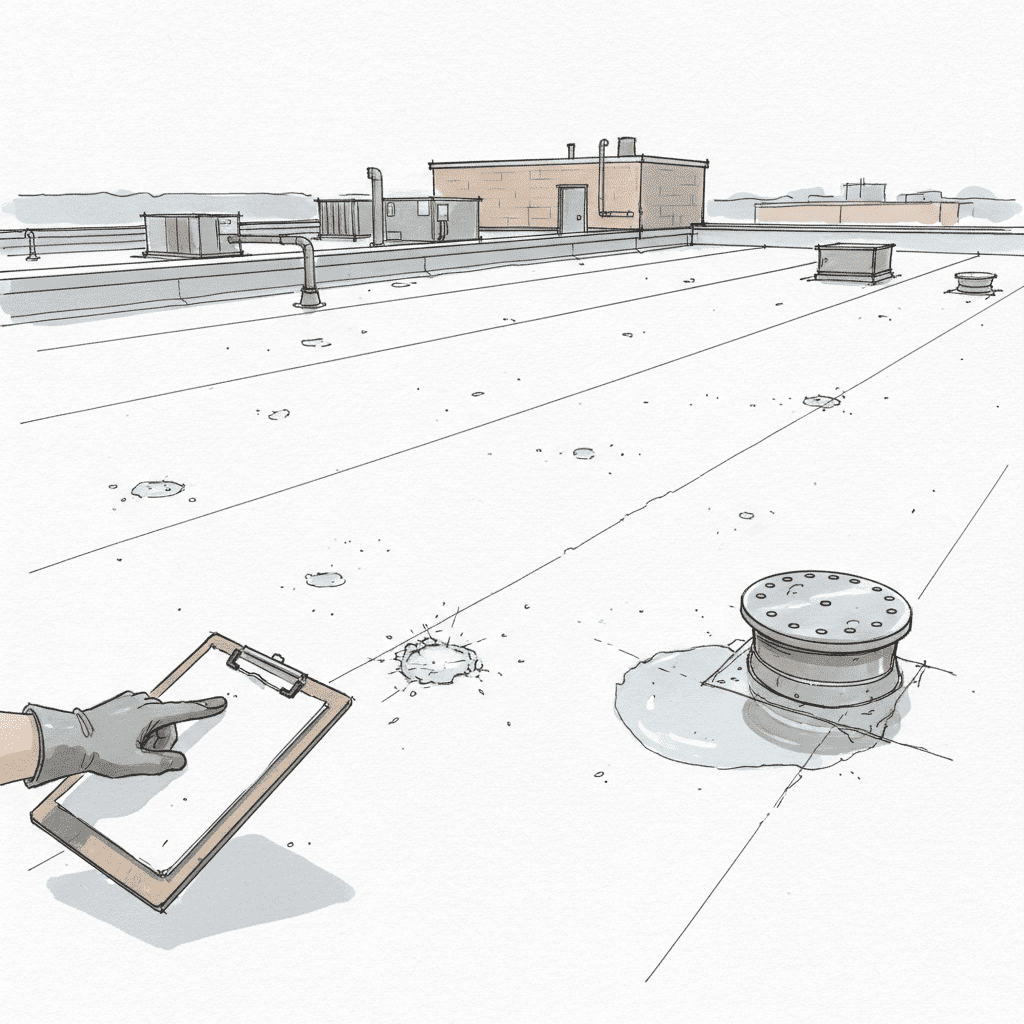
An insurance claim is an adversarial process that is won or lost based on the quality of evidence. We operate on the principle of building an irrefutable case from the outset. Our process for establishing a chain of custody for evidentiary data is meticulous. It begins with high-resolution photographic documentation, with every photo geotagged and timestamped. We use scales and calipers for precise hail stone measurement and document impact density per standard 10’x10′ test squares. This physical evidence is correlated with third-party meteorological data, including Doppler radar signatures confirming the size and velocity of hail over your specific property address. When necessary, we collect witness statements from tenants or staff. All of this data is compiled into a single, cohesive forensic report that forms the backbone of the claim, leaving no room for ambiguity or dispute from the insurance carrier.
Forensic Analysis of Hail Impact Across Commercial Roofing Systems
A generic inspection is insufficient for substantiating a high-value commercial insurance claim. A forensic engineering approach is required to analyze the specific failure points of your particular roofing system according to ASTM standards. Each system—TPO, EPDM, Modified Bitumen, Metal—reacts to hail impact differently. Understanding these unique failure modalities is essential to identifying latent damage that will cause premature system failure and void your warranty. We move beyond a simple visual check to conduct a scientific analysis, including core sampling and impact testing where necessary, to quantify the extent of the functional damage to the asset.
Single-Ply Membranes (TPO/EPDM): Identifying Brittleness Fractures and Compromised Seams
Thermoplastic Polyolefin (TPO) and Ethylene Propylene Diene Monomer (EPDM) are vulnerable to a specific type of damage known as membrane bruising or fracturing. High-velocity hail impacts can stretch the membrane beyond its elastic limit, causing fractures in the polymer matrix, especially in older membranes that have lost plasticity due to UV exposure. These fractures often occur over fasteners or sharp edges on the substrate below. Crucially, the impact can also compromise the scrim reinforcement layer within the membrane, severely reducing its tensile strength and puncture resistance. Heat-welded seams on TPO systems are another critical inspection point, as a powerful impact near a seam can compromise the weld’s integrity, creating a future entry point for water. These are not visible leaks; they are ticking time bombs for catastrophic failure.
Modified Bitumen & BUR: Assessing Granule Loss and Substrate Bruising
On asphaltic systems like Modified Bitumen and Built-Up Roofing (BUR), the ceramic-coated granules are the primary defense against UV radiation. Hail acts like an abrasive blast, stripping these granules away and exposing the underlying bitumen to direct sunlight. This exposure accelerates the aging process, causing the asphalt to become brittle and crack. More significantly, large hailstones can cause substrate bruising, fracturing the layers of reinforcing felt beneath the surface. This creates a weak point in the membrane that will eventually split under thermal stress. Our analysis includes granule adhesion tests and, if necessary, core sampling to inspect for delamination between the plies, which is definitive proof of functional damage.
Metal Roofing Systems: Evaluating Panel Deformation and Coating Integrity
While often perceived as resilient, metal roofing systems are susceptible to damage that compromises their long-term performance. The obvious damage is denting and pitting, which can be severe enough to cause panel deformation and disrupt the proper flow of water into gutters. However, the more insidious damage is to the coating system. A hail impact can fracture the protective paint or Galvalume coating, creating a microscopic entry point for moisture. This leads to corrosion that spreads beneath the coating, eventually causing panel failure. Furthermore, impacts near fasteners can break the neoprene washer seals, creating immediate, hard-to-find leaks. A proper assessment requires evaluating not just the dents, but the integrity of every coating and fastener seal across the roof.
Diagnostic Technologies: Leveraging Infrared Thermography for Sub-Surface Analysis
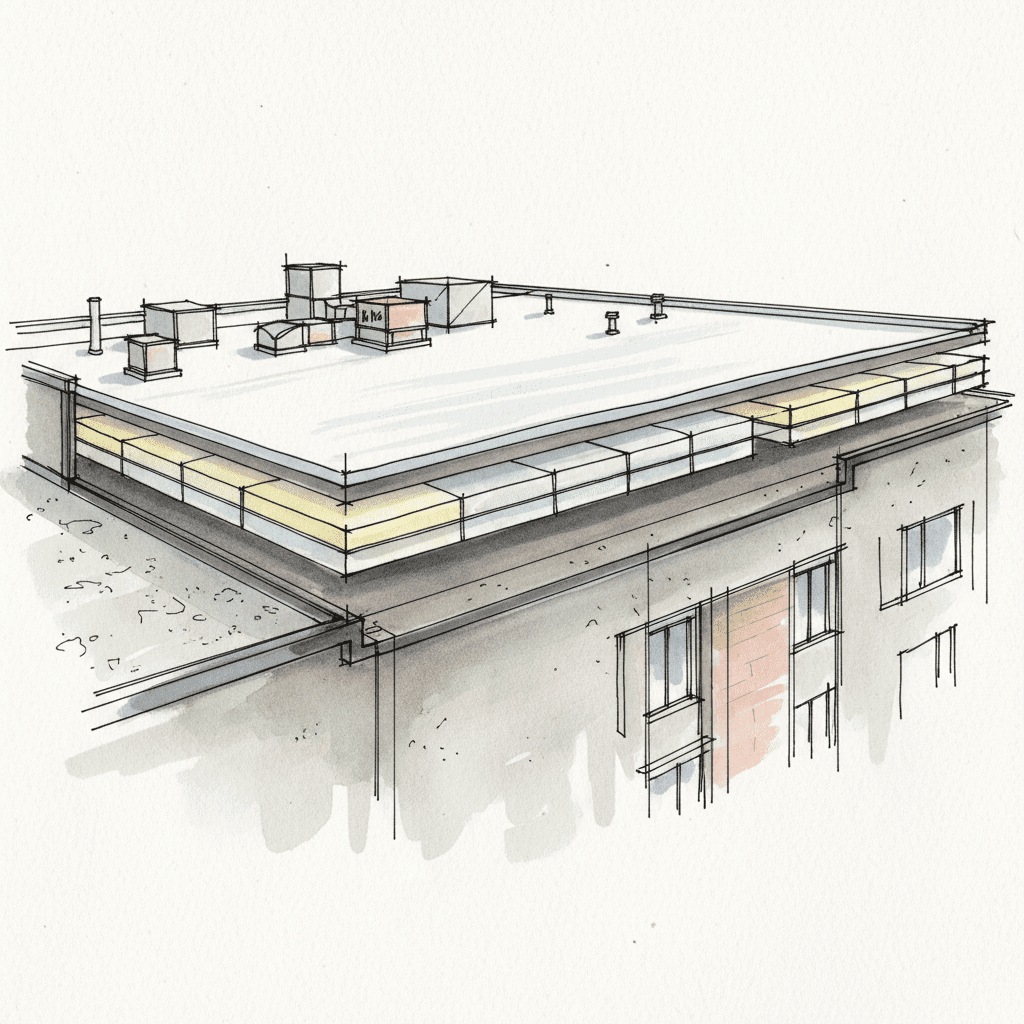
Visual inspection only reveals surface-level conditions. To understand the true financial impact of a hail event, we must analyze the sub-surface components. We utilize high-resolution infrared thermography as a primary nondestructive testing method. This technology allows us to identify areas of saturated insulation beneath the roof membrane with surgical precision. Wet insulation has zero insulation R-value, meaning your building is losing significant energy, placing a constant, elevated load on your HVAC systems and increasing utility costs. This saturated insulation also traps moisture against the roof deck, promoting corrosion on metal decks or rot in wood decks. The infrared data provides indisputable evidence to the insurance carrier that a simple membrane repair is insufficient and that removal and replacement of compromised insulation is required to restore the asset to its pre-loss condition and energy efficiency.
| Roofing System | Primary Failure Mode | Latent Financial Risk | Forensic Indicator |
|---|---|---|---|
| TPO / EPDM | Membrane Fracturing/Bruising | Premature system failure, warranty void | Core sample shows compromised scrim |
| Modified Bitumen | Granule Loss & Substrate Fracture | Accelerated UV degradation, delamination | Exposure of asphaltic layer, mat bruising |
| Metal | Coating Fracture & Seal Failure | Panel corrosion, systemic leaks | Microscopic cracks in coating, broken fastener seals |
| All Systems | Insulation Saturation | Loss of R-Value, deck corrosion, increased utility costs | Thermal anomalies via infrared thermography |
Quantifying Long-Term Liability and Diminished Asset Lifespan
A post-hail audit is fundamentally an exercise in capital planning. The goal is to accurately quantify the damage not just for an immediate insurance claim, but to understand how the event has impacted the asset’s lifecycle and your long-term total cost of ownership. Ignoring the sub-surface and long-term effects of a hail event is fiscally irresponsible, as it guarantees larger, unplanned capital outlays in the future. We provide the data necessary to model these future costs and make informed decisions about repair versus replacement, grounded in financial reality, not a contractor’s expediency.
Modeling the Financial Impact of Compromised Insulation (R-Value Loss)
The thermal resistance (R-value) of your roofing insulation is a critical component of your building’s energy efficiency. When hail damage allows water to saturate polyisocyanurate or other rigid foam insulation, its R-value plummets to near zero. This has a direct and measurable impact on your operating budget. The increased thermal transfer forces your HVAC systems to run longer and harder to maintain interior temperatures, leading to a significant increase in monthly utility costs. Furthermore, this sustained overuse accelerates the depreciation of the HVAC units themselves, shortening their service life and bringing forward a major capital replacement. We model this financial impact, providing clear projections of increased energy consumption that justify a scope of work including full insulation replacement, ensuring compliance with current building codes and restoring the asset’s designed performance.
Projecting Premature System Failure and Future Capital Outlays
Every commercial roof has a predictable asset lifecycle. A hail event can reduce a 20-year roof to a 5-year liability. Our forensic analysis projects this accelerated aging. By identifying widespread membrane bruising, compromised seams, and granule loss, we can model the roof’s new, shortened lifespan. This data is critical for your capital reserve study. Instead of planning for a roof replacement in year 20, you may now face a full replacement in year 7. Ignoring this reality means the expense will be a surprise, forcing an emergency allocation of capital. By proactively documenting the damage and securing a proper insurance settlement for a full replacement, you realign your capital plan with the asset’s actual condition. This is the essence of proactive roof asset management: converting an unforeseen liability into a planned, funded project that eliminates future risk and resets the asset’s lifecycle.
Assembling an Evidentiary Package for Insurance Carrier Negotiations
Negotiating with an insurance carrier is not a collaborative process; it is a financial negotiation where the carrier’s primary goal is to minimize their payout. Presenting them with a simple contractor’s estimate is wholly inadequate. Success requires presenting an irrefutable, engineer-led evidentiary package that systematically proves the extent of the damage and justifies the required scope of work. Our role is to act as your fiduciary, arming you with the documentation and expert analysis required to achieve a fair settlement that fully restores the value and performance of your asset.
The Critical Role of Third-Party, Engineer-Led Assessments
The insurance adjuster works for the insurance company. A standard roofing contractor works to get a job. A forensic engineer works to uncover objective, scientific truth. An engineer-led assessment carries significantly more weight in a claim dispute. It provides an unbiased, third-party analysis of the damage based on established scientific principles and ASTM testing standards. This objective analysis removes the perception of bias and transforms the negotiation from an argument over opinions to a review of facts. This documentation is your most powerful tool for dispute resolution and serves as the foundation for appraisal or expert witness testimony should the carrier refuse a fair settlement.
Aligning Repair vs. Replacement Strategy with Policy Language and Building Codes
The decision to repair or replace is not arbitrary; it is governed by a combination of your insurance policy language, local building codes, and the physical condition of the roof. An Actual Cash Value (ACV) policy will pay less than a Replacement Cost Value (RCV) policy due to depreciation. However, even with an ACV policy, a full replacement may be justified if repairs are not feasible or would not return the system to a serviceable condition. Furthermore, many jurisdictions have building codes that require a full tear-off if more than 25% of the roof is damaged or if a second overlay is present. Ordinance or Law coverage within your policy is designed to cover these code-mandated upgrades. We analyze your specific policy language and cross-reference it with local codes and our forensic findings to build a cohesive strategy that justifies the correct course of action—one that is compliant, insurable, and protects the long-term value of your asset.
The RocStout Protocol: A Framework for Fiscal Certainty and Operational Continuity
Choosing a commercial roofing partner is a significant capital decision. The industry is plagued by contractors who create the very operational disruption you seek to avoid. Their scheduling failures, safety breaches, and poor communication create tenant issues and expose you to liability. RocStout was founded on a fundamentally different model. We are not contractors; we are fiduciaries in project management. Our protocol is engineered to deliver fiscal certainty through transparent, line-item reporting and a ‘No Surprise’ billing philosophy, and to guarantee operational continuity through militant adherence to safety, scheduling, and stakeholder communication.
Executing Restoration Without Disrupting Tenant Operations
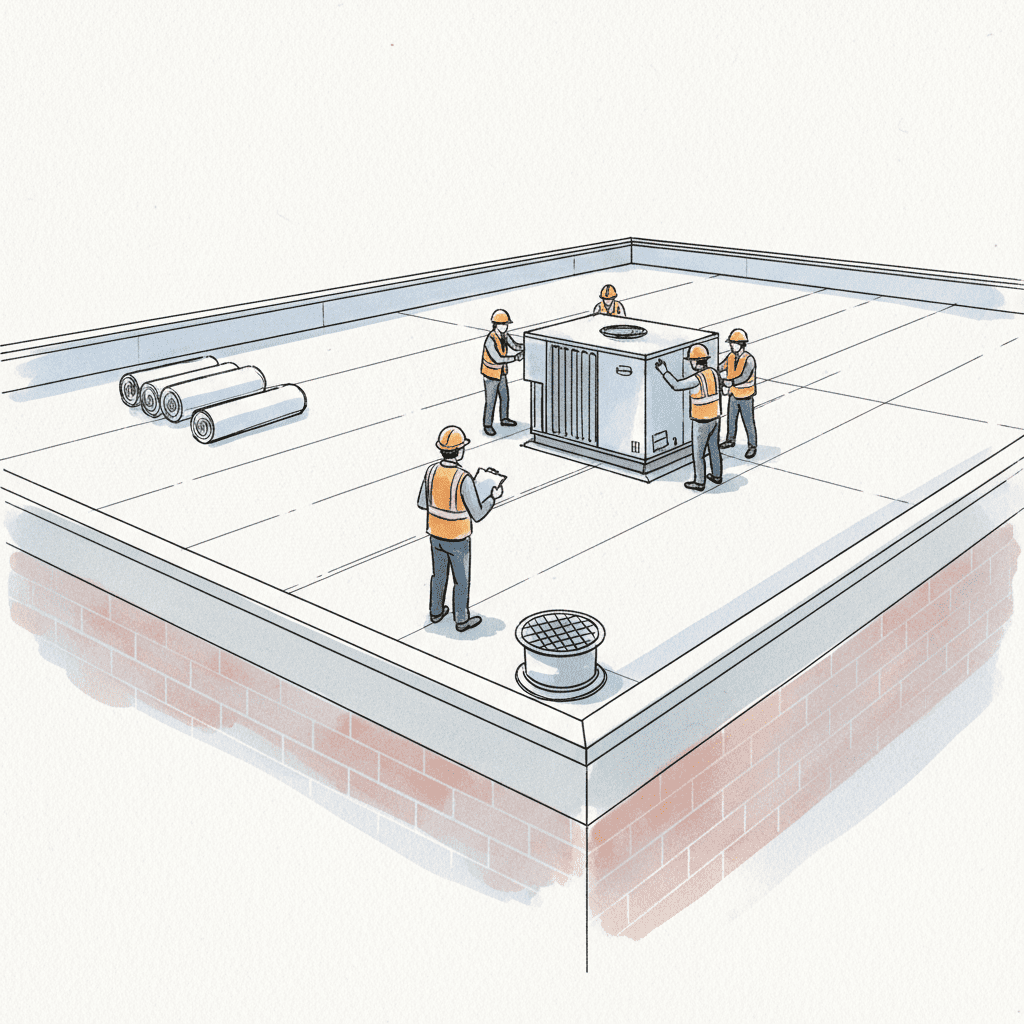
The true cost of a roof replacement is measured in disruption. Our project management protocol is designed with a singular focus: zero tenant disruption. This begins with comprehensive logistics planning, including designated material staging areas, debris management plans, and defined work hours to minimize noise. For occupied facilities, we utilize phased construction to ensure we are only working over non-critical areas during business hours. Daily stakeholder reporting keeps your facility management team informed of our progress, and a formal tenant communication plan ensures everyone from the loading dock to the executive suite understands the project timeline. Our crews operate under strict OSHA compliance, ensuring the safety of your employees and our team is never compromised. We view your operational continuity as a key performance indicator of our success.
From Forensic Report to Capital Plan: Your Partner in Asset Preservation
Our engagement does not end when the project is complete. The forensic report and restoration project are the first steps in a long-term partnership focused on capital asset preservation. We provide you with the documentation and data needed to integrate your new roof system into a multi-year lifecycle plan. This proactive approach to asset management transforms your roof from a reactive liability into a predictable, manageable component of your capital budget. By partnering with RocStout, you are not simply hiring a roofer; you are retaining a fiduciary advisor dedicated to protecting your asset, mitigating your risk, and providing the fiscal certainty required to manage your property portfolio effectively.