Understanding Commercial Roof Depreciation as a Capital Asset
A commercial roof’s depreciation schedule is a financial reporting mechanism, mandated by the IRS, that treats your roofing system not as a mere expense, but as a long-term capital asset whose cost is systematically allocated over a designated useful life. For any executive tasked with managing a facility’s balance sheet, viewing the roof through this financial lens is non-negotiable. It transforms the conversation from a reactive repair cost into a proactive strategy for capital asset preservation and tax management.
The Fiduciary Role in Managing Building Envelope Assets
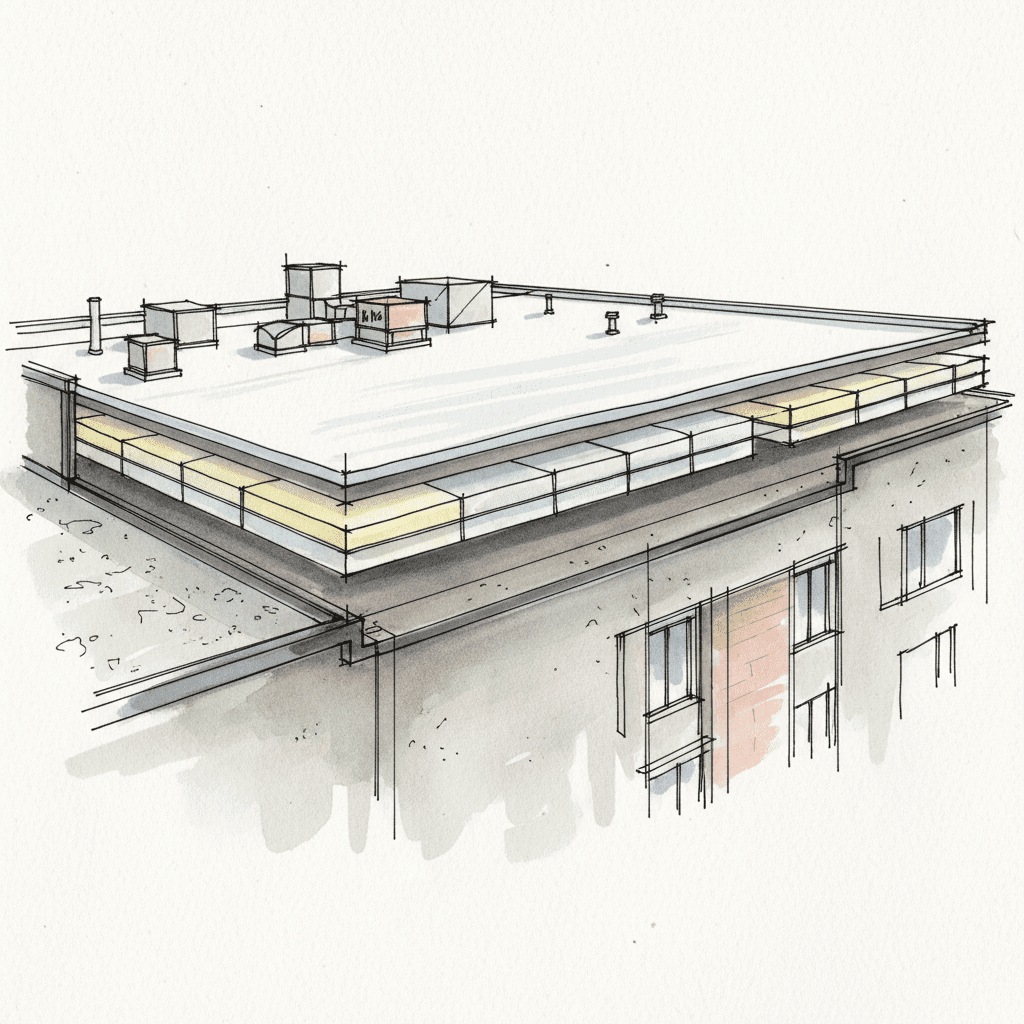
As a fiduciary for the property, your duty extends beyond simple maintenance; it requires the strategic management of every component that contributes to the building’s value and operational integrity. The building envelope—comprising the roof, walls, and foundation—is your primary defense against revenue-destroying water intrusion, inventory damage, and tenant disruption. A failure in this system represents a direct financial liability. Managing this asset responsibly involves mitigating risk and maximizing its long-term value, not seeking the lowest-cost temporary fix. The industry’s common practice of accepting the lowest bid is a breach of this fiduciary duty, as it invariably prioritizes short-term cost savings over long-term asset stability and risk mitigation.
Defining the ‘Placed in Service’ Date for Accurate Scheduling
The depreciation start date is determined by the ‘placed in service’ date, a critical milestone for your accounting department. According to IRS Publication 946, this is not necessarily the date the final invoice is paid, but the date the asset is ready and available for its specific use. For a new roof, this means the day it is substantially complete and begins its function of protecting the building. Establishing this date correctly is the first step in creating an accurate depreciation schedule for the capital expenditure. Any ambiguity here can create compliance issues during a financial audit. Our standard operating procedure includes providing clear, date-stamped completion documentation precisely for this purpose, ensuring your financial reporting is built on a foundation of verifiable data.
Calculating Depreciation: The MACRS 39-Year Schedule for Commercial Roofs
The Internal Revenue Service mandates the use of the Modified Accelerated Cost Recovery System (MACRS) for depreciating most tangible property. Under MACRS, commercial roofs are not considered standalone assets but are classified as an integral part of the building structure. As such, they fall under the category of ‘nonresidential real property’ and are assigned a 39-year recovery period under the General Depreciation System (GDS). This long-term schedule has significant implications for capital planning, underscoring the importance of investing in a roofing system engineered for longevity.
Applying the Straight-Line Method to Nonresidential Real Property
For nonresidential real property, MACRS requires the use of the straight-line depreciation method. This means the cost basis of the roof (the total capitalized cost of the new system) is deducted in equal amounts over the 39-year lifespan. This provides predictable, consistent annual depreciation deductions that lower your taxable income. For example, a $500,000 roof replacement, when capitalized, would generate an annual depreciation deduction of approximately $12,820 ($500,000 / 39 years). This contrasts with repair expenses, which are deducted entirely in the year they are incurred. While a full immediate deduction may seem appealing, misclassifying a capital improvement as a repair is a significant compliance risk that can lead to financial penalties.
Implications of the 39-Year Timeline on Capital Planning and ROI
A 39-year depreciation schedule is a stark financial reminder that a roof replacement is a long-term capital investment. Choosing an inferior system based on a low initial bid is fiscally irresponsible. If a substandard roof fails in year 15, you are left with a non-performing asset that must still be depreciated for another 24 years, even as you face the unbudgeted capital expenditure of a premature replacement. A properly engineered and installed roofing system, however, aligns with this timeline. It provides decades of reliable service, allowing you to realize the full tax benefit of the depreciation schedule while protecting the building and its revenue-generating operations. True ROI is calculated not by the initial bid price, but by the total cost of ownership over the asset’s entire service life.
Financial Classification: Capital Improvement vs. Deductible Repair Expense
The distinction between a capital improvement and a repair expense is one of the most critical—and scrutinized—areas in commercial property accounting. A repair is an activity that keeps the property in its ordinary, efficient operating condition; it is a deductible operational expense (OpEx). A capital improvement, however, is an investment that betters the property, adapts it to a new use, or restores it. These are capitalized and depreciated over time. Misclassification carries severe financial penalties and is a common trigger for IRS audits.
IRS Criteria for Betterments, Restorations, and Adaptations (The ‘BRA’ Test)
To provide clarity, the IRS uses the ‘BRA’ test to determine if an expenditure must be capitalized. An expense is a capital improvement if it results in a:
- Betterment: An improvement that ameliorates a material condition or defect, results in a material addition to the property, or increases its capacity, productivity, or efficiency. Upgrading from a TPO membrane to a more impact-resistant PVC system is a betterment.
- Restoration: An action that returns the property to its ordinary operating condition after it has fallen into a state of disrepair. This includes replacing a substantial structural part of the property, such as a full roof membrane replacement.
- Adaptation: A modification that changes the property for a new or different use. For example, modifying the roof structure to support heavy new HVAC equipment.
A simple patch to fix a leak is a repair. A full tear-off and replacement with a new, energy-efficient system is a capital improvement. Choosing a contractor who understands and documents work according to these criteria is essential for tax compliance.
| Activity | Financial Classification | Financial Treatment | Fiduciary Implication |
|---|---|---|---|
| Patching a single leak | Repair & Maintenance | Deductible OpEx (Current Year) | Necessary but does not improve asset value. |
| Full membrane replacement | Capital Improvement (Restoration) | Capitalized & Depreciated (39 Years) | Preserves and restores core asset value. |
| Adding insulation to increase R-value | Capital Improvement (Betterment) | Capitalized & Depreciated (39 Years) | Increases asset efficiency and reduces long-term OpEx. |
| Roof overlay (re-cover) | Capital Improvement (Restoration) | Capitalized & Depreciated (39 Years) | High-risk approach; hides potential structural defects and creates future liability. |
Documentation Protocols to Substantiate Financial Classification
An audit trail is your only defense. The low-bid contractor who provides a one-line invoice stating ‘Roof Work’ creates a significant financial liability for your organization. To withstand scrutiny, you require documentation that clearly delineates the scope of work. Our standard reporting includes detailed line-item invoices, photographic evidence of pre-existing conditions, material specifications, and a narrative scope of work that explicitly maps to the IRS’s BRA criteria. This isn’t just paperwork; it is a strategic asset that substantiates your financial classifications and protects the company from compliance penalties.
Analysis: How Misclassification Impacts P&L Statements and Asset Valuation
Improperly expensing a capital improvement artificially deflates your current year’s profit on the P&L statement and lowers key metrics like EBITDA. Conversely, improperly capitalizing a routine repair overstates your profit and inflates the value of assets on your balance sheet. Both errors present a distorted picture of the company’s financial health to stakeholders, lenders, and potential investors. Accurate classification is fundamental to sound financial governance and accurate asset valuation.
Strategic Tax Planning: Leveraging Section 179 and Bonus Depreciation
While the 39-year schedule is the standard, the tax code provides strategic opportunities for asset owners to accelerate deductions on qualified improvements. Understanding these provisions is key to optimizing the cash flow impact of a major roofing project. Please consult with a qualified tax professional to confirm eligibility for your specific circumstances.
Qualifying Roof Replacements Under Section 179 for Immediate Expensing
Historically, Section 179 applied primarily to equipment and personal property. However, the Tax Cuts and Jobs Act (TCJA) expanded its definition of ‘qualified real property’ to include improvements to the interior of nonresidential buildings. Critically, it now also includes roofs, HVAC systems, and fire protection systems. This allows a business to elect to treat the cost of a new roof system as a Section 179 expense, deducting the full cost in the year it is placed in service, up to the statutory limit (over $1 million). This can provide a substantial, immediate tax savings that significantly improves the first-year ROI of the project.
Using Bonus Depreciation to Mitigate First-Year Tax Burdens
Bonus depreciation is another powerful tool for accelerating cost recovery. It allows for an additional first-year deduction for the cost of qualified property. For property acquired and placed in service in recent years, this has often been 100%, though the percentages are scheduled to phase down. This applies to assets with a recovery period of 20 years or less, which now includes Qualified Improvement Property (QIP). By working with a tax advisor, you can determine how these provisions apply to your roofing project, potentially allowing you to expense a significant portion—or all—of the cost in the first year, dramatically improving cash flow management.
Integrating Depreciation into Lifecycle Asset Management and CapEx Forecasting
The depreciation schedule is an accounting tool, but the underlying principle—that a roof is a long-term asset—must drive your physical asset management strategy. The goal is to ensure the roof’s physical service life meets or exceeds its financial depreciable life, maximizing the return on your capital investment.
Modeling Total Cost of Ownership Beyond the Initial Installation Bid
The contractor’s bid is merely the first entry on a long-term ledger. The Total Cost of Ownership (TCO) includes the initial investment plus all future costs: proactive maintenance, repairs, energy consumption, and the financial impact of potential operational downtime. A low-bid installation using inferior materials may have a 20% lower initial cost but a 200% higher TCO over 15 years due to frequent repairs and premature failure. We provide lifecycle cost analysis (LCCA) that models these variables, allowing you to make a capital decision based on long-term fiscal outcomes, not short-term price tags.
How Proactive Maintenance Extends Useful Life Beyond the Depreciation Schedule
A roof depreciates on paper over 39 years. Deferred maintenance can cause it to fail physically in 12. Conversely, a proactive maintenance program—involving semi-annual inspections, debris removal, and minor repairs—is a low-cost operational expense that protects your multi-million dollar capital asset. This strategy extends the roof’s actual useful life well beyond the 20- or 30-year warranty period, pushing the next major capital expenditure further into the future. This is the cornerstone of proactive asset preservation, directly contrasting the industry’s default model of expensive, reactive emergency repairs.
Executing a Fiscally Sound Roofing Strategy with RocStout
Choosing a roofing partner is a capital planning decision. It requires a firm that operates not as a mere contractor, but as a fiduciary advisor committed to protecting your asset and ensuring operational continuity.
Our Standard Operating Procedure: Delivering Fiscal Certainty and Audit-Ready Reporting
Our methodology is engineered to eliminate the financial and operational risks common in commercial construction. We deliver fiscal certainty through a rigid, process-driven approach. This includes:
- Line-Item Reporting: Every proposal and invoice provides the granular detail required for accurate financial classification and audit defense.
- ‘No Surprise’ Billing: Our change order protocol is rigorous and transparent. You maintain complete control over the capital budget from start to finish.
- Comprehensive Asset Documentation: Upon completion, we provide a full handover package including warranties, material data, and as-built drawings—the foundational documents for your asset management file.
Partnering with Your Capital Planning Process to Mitigate Operational Disruption
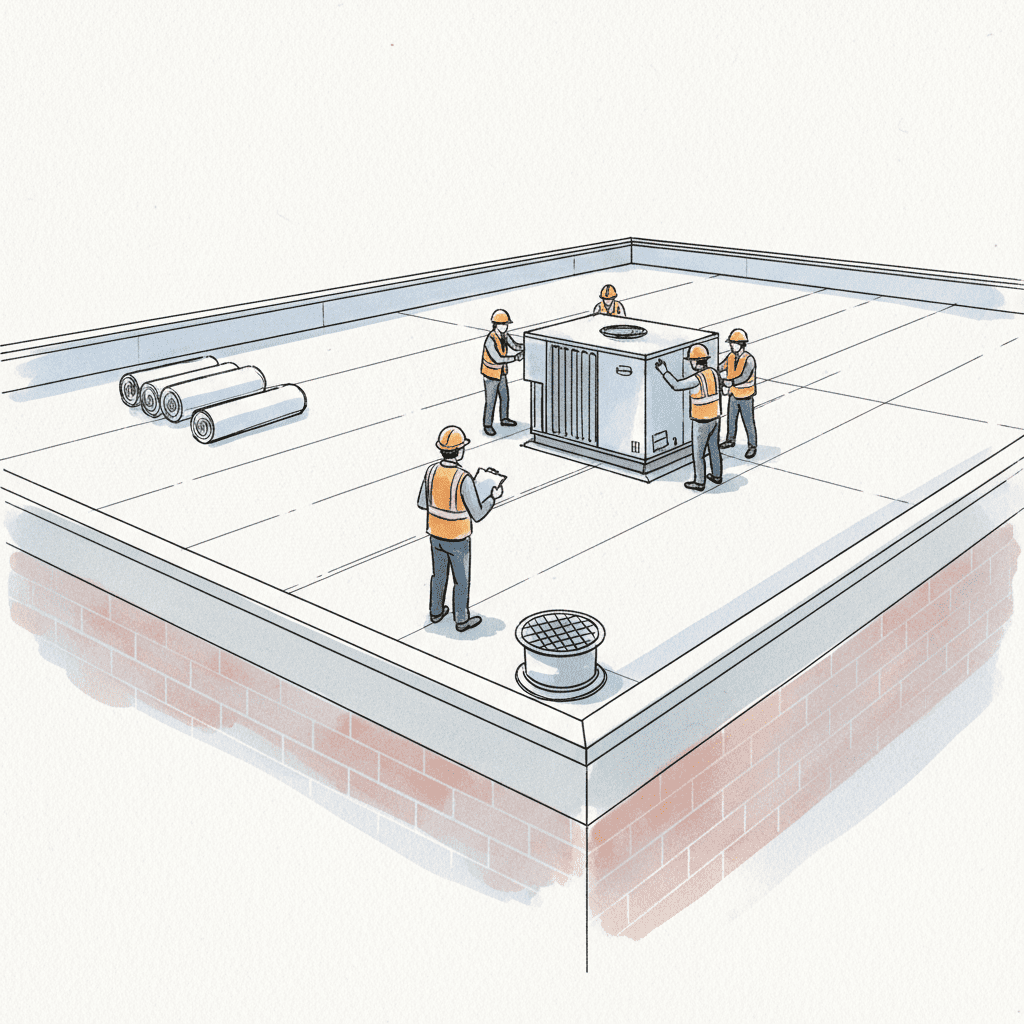
We understand the true enemy is not the cost of the roof, but the cost of operational disruption. Our project management is built around a core principle of zero interference with your revenue-generating activities. We achieve this through strict adherence to safety and scheduling protocols, including non-negotiable OSHA compliance, clearly defined work zones, and proactive tenant communication plans. By partnering with RocStout, you are not just procuring a roof; you are investing in business continuity and mitigating the single greatest liability in commercial construction: an unsafe, unpredictable, and disruptive contractor.